
Oil Shocks, Political Upheaval and the One Solution Governments Keep Ignoring
 17 Maret 2026

Credit: Marcelo Del Pozo/Reuters via Gallo Images
By Andrew Firmin
LONDON, Mar 16 2026 (IPS)
Once again, global oil prices are spiking, driven by the Israeli-US war against Iran. With Iran retaliating by attacking infrastructure and transport hubs and blocking the Strait of Hormuz, through which one-fifth of the world’s oil passes, oil supplies from the region are being choked, pushing up prices. The cost of a barrel of Brent crude – the international benchmark for oil prices – stood at US$73 before the conflict but has surged beyond US$100 since. It could go higher still as war continues.
The impacts are already being felt when drivers fill up their petrol- and diesel-powered vehicles. But they go much wider. Bigger household energy bills will likely result, while businesses will pass on their increased costs in the form of higher prices. Russia’s 2022 full-scale invasion of Ukraine sent oil prices soaring and sparked a global cost-of-living crisis, and now, as many economies seemed to be recovering, the war in the Gulf has brought another shock. Impacts could be political as well as financial: in numerous countries, the cost-of-living crisis helped drive voters towards right-wing populist and nationalist politicians. Recent years have seen Gen Z-led protests erupt in countries around the world, fuelled in part by young people’s anger at failing economies.
In a world increasingly characterised by conflict and with powerful states tearing up the international rulebook in pursuit of material interests, more oil shocks and big economic and political impacts seem inevitable. Governments typically react with economic policies that fail to protect those with the least, and by meeting political unrest with repression. They should consider another way.
The world will remain vulnerable to oil price shocks only for as long as it stays dependent on oil. The climate crisis compels a rapid move away from fossil fuel dependency to abate the worst impacts of global heating. Increasingly, this should also be seen as a matter of economic and political security.
Some steps have been taken in the right direction. Renewables now provide over 30 per cent of global electricity. Investments in renewables more than double those in fossil fuels. But fossil fuel companies have immense power and are determined not to give it up. That was reflected in the fact that 1,600 fossil fuel lobbyists attended the latest global climate summit, COP30 in Brazil, and succeeded in preventing any new commitment to end fossil fuel extraction. Their power is shown in the lawsuit an oil company brought against Greenpeace, leading to a widely criticised trial in North Dakota, USA, with the campaigning organisation facing a punitive US$345 million damages bill. Their influence was reaffirmed by Donald Trump’s election win, after a campaign in which fossil fuel companies gave US$450 million in donations to Trump and his allies – and they were rewarded by US intervention in Venezuela.
Fossil fuel companies are determined to hold back the tide of renewables for as long as possible, because every day of delay is another day of profit, even though every fraction of a degree of temperature rise means avoidable suffering for millions of people. Delay is the new climate denial.
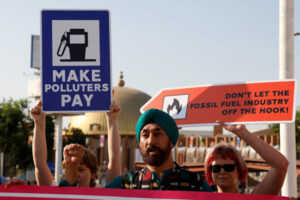
As the latest State of Civil Society Report points out, civil society’s working to make the difference, urging governments to hasten the transition and calling on global north states to make funding available for global south states to decarbonise and adapt to climate impacts. Civil society is exposing the environmental devastation caused by extraction and the complicity of fossil fuel companies in human rights abuses. Its strategies include advocacy, public campaigning, protests, direct action and, increasingly, litigation.
In 2025, climate litigation scored some big successes. The International Court of Justice (ICJ) issued an unprecedented advisory opinion, ruling that states have a legal duty to prevent environmental harm, which requires them to mitigate emissions and adapt to climate change. This victory originated in civil society: in 2019, student groups from eight countries formed the Pacific Islands Students Fighting Climate Change network to persuade their governments to seek an ICJ ruling.
Following extensive civil society engagement, the Inter-American Court of Human Rights issued a similar ruling. The African Court for Human and Peoples’ Rights is set to issue its advisory opinion following a petition brought by the African Climate Platform, a civil society coalition.
These rulings can seem symbolic, but they strengthen national-level efforts to hold states and corporations accountable. These have paid off recently too. In 2025, two South African groups stopped an offshore oil project after a court found its environmental assessments were deeply flawed. More litigation is coming, including in New Zealand, where civil society has filed a lawsuit after the government weakened its emissions reduction plan.
But civil society faces a backlash. Around the world, climate and environmental activists and their allies, Indigenous and land rights defenders, experience severe state and corporate repression.
Last year in Uganda, authorities arrested 11 activists for protesting against the construction of the East African Crude Oil Pipeline. In Peru, police used teargas and non-lethal weapons against people blocking a road to protest against a mine. In Cambodia, five young activists from the Mother Nature environmental group have been in jail since July 2024.
The French government has repeatedly vilified environmental campaigners and deployed police violence against protests, while last year the German government launched an inquiry into public funding of environmental groups and the Dutch parliament adopted a motion condemning Extinction Rebellion and urging the removal of its tax-exempt status.
As the latest oil price shocks reverberate around the global economy, governments should learn the lessons. As economies deteriorate, the temptation will be to say that transition is a luxury, something that can be put off even further. This is the wrong lesson: recent research in the UK suggests that the cost of achieving net zero will be about the same as the cost of another oil price crisis. Economic and political security lies in ending fossil fuel dependency as quickly as possible. To learn the right lessons, governments should stop repressing climate activism and instead listen to and work with civil society.
Andrew Firmin isCIVICUS Editor-in-Chief, co-director and writer for CIVICUS Lens and co-author of the State of Civil Society Report.
For interviews or more information, please contact [email protected]