UNPFII Intervention on Behalf of the Chimpu Warmi Network in Bolivia
22 April 2026agnes
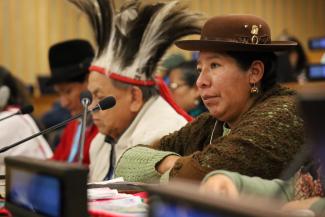
April 21, 2026, New York
Statement presented at the 25th session of the UN Permanent Forum on Indigenous Issues.
Rosa Fátima Mamani Quispe, on behalf of the Chimpu Warmi Network of Bolivia, a Cultural Survival Indigenous Community Media Fund partner, participated in the UNPFII, where she called on the Bolivian government to address the demands of the indigenous peoples who have witnessed the death of Lake Poopo and Mamacocha (Mother Earth), She also emphasized that mining companies are destroying Bolivian territory with extremely toxic substances that harm the health of the land and of our indigenous sisters and brothers.
Mr. President, while congratulating you on your election, I wish to thank the organization International Work Group for Indigenous Affairs (IWGIA) for making my participation in this 25th session of the Permanent Forum possible. I bring the message of the indigenous peoples—and particularly the indigenous women—of Bolivia, who are fighting to defend our territories, our living spaces, and our right to self-determination. For us, the theme of this session—”Ensuring the health of Indigenous Peoples, including in the context of conflicts”—offers an ideal space for our voices and our thoughts to help safeguard the very fabric of life.
We, indigenous women, have sustained life by preserving our knowledge and wisdom, our languages, our institutions and systems of self-governance, and our life plans—by spinning and weaving the threads of life itself. Our textiles serve as the living memory of life—an art form we have inherited from our female ancestors. The defense of our territory is, in essence, the defense of life itself; for our peoples, the land is Woman—it is *Pachamama*, our Mother Earth, fertile and bountiful.
The United Nations Declaration on the Rights of Indigenous Peoples recognizes our rights to the lands, territories, and resources that we have traditionally owned, occupied, or otherwise used. However, within the Bolivian State, these rights continue to be violated. Our territories are being encroached upon and subjected to violence through extractivist policies—driven by mining companies and informal mining operations—and through institutional actions such as those of the National Institute for Agrarian Reform (INRA) and the Authority for the Oversight and Social Control of Forests and Land (ABT). These actions facilitate the entry of third parties—formerly referred to as “colonizers” and now termed “intercultural settlers”—as well as so-called “mining cooperatives,” into indigenous territories. In doing so, they weaken and fragment our autonomy, our ways of life, and our systems of self-governance, while simultaneously polluting and sickening our Mother Earth.
Mining operations—particularly gold mining, with its indiscriminate use of mercury—have inflicted severe environmental damage. They have contaminated rivers, destroyed ecosystems, impoverished indigenous territories, and caused illness within our communities and families. For Indigenous women, this has even more profound impacts: it is becoming increasingly difficult to access water, healthy food, and the means to sustain our lives and those of our families. Furthermore, it creates environments rife with violence, disproportionately affecting the most vulnerable groups: women, children, and the elderly.
In the Altiplano, we are enduring the pain caused by the death of Lake Poopó—our *Mamacocha* (Mother Lake)—a sacred living entity for the Andean peoples. Just as the lake has died, many communities today live suspended between grief and resilience. We know that when a lake dies, it is not only the water that vanishes; the culture, worldview, and collective memory of the people are wounded as well.
For us, health is not understood solely through the Western lens of individual well-being. For our communities, health is an integral, reciprocal relationship with Mother Earth. If Mother Earth is healthy, we are healthy too, for she provides us with sustenance, balance, and the space to live. But if Mother Earth is ailing, we too fall ill—physically, emotionally, and spiritually.
It pains us to see our sacred sites destroyed: the *Mamacocha*, the hills, the rivers, and our ceremonial spaces—all poisoned by mercury, arsenic, and other elements harmful to life. When this occurs, the bond of care between the community and its environment is severed. Therefore, for us, speaking of well-being means speaking of respect for nature and our territory, and of the protection of our collective rights.
As Indigenous women, we stand firm; we are resisting, sowing seeds of hope, and weaving the fabric of life. We defend our territory because we defend life itself. We defend the water because we defend the future. We demand that the State fulfill the commitments it undertook in the United Nations Declaration on the Rights of Indigenous Peoples—a declaration that, in Bolivia, has held the force of law (Law 3760) since November 7, 2007, and is therefore legally binding. The State must shoulder its responsibilities to ensure an environment that enables Indigenous peoples to live with dignity, health, and freedom.
Thank you very much.