
Bombing and Ballots, Myanmar’s Contentious Election
 6 Januari 2026

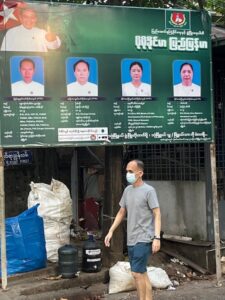
A man walks past a campaign poster for the military’s proxy party USDP ahead of strictly controlled elections in Myanmar. Credit: Guy Dinmore/IPS
By Guy Dinmore
YANGON, Myanmar and BANGKOK , Jan 6 2026 (IPS)
With thousands of civilians killed in years of civil war and over 22,000 political prisoners still behind bars, no one was surprised that early results from Myanmar’s first but tightly controlled elections since the 2021 coup show the military’s proxy party speeding to victory.
“How can you hold elections and bomb civilians at the same time?” asked Khin Ohmar, a civil rights activist outside Myanmar who is monitoring what the resistance forces and a shadow government reject as “sham” polls.
The junta had already cleared the path towards its stated goal of a “genuine, disciplined multi-party democratic system” by dissolving some 40 parties that refused to register for polls, which they regard as illegitimate, with their leaders and supporters still in prison.
These include the National League for Democracy (NLD) and its leader, Aung San Suu Kyi, who won a landslide second term in the 2020 elections – only for the results to be annulled by Senior General Min Aung Hlaing, a coup leader and self-appointed acting president. Mass street protests were crushed in early 2021 and war spread across Myanmar.
Although these elections will deliver just a façade of the legitimacy craved by some of the generals, they did succeed in projecting a power and authority that was quickly slipping away just two years ago as long-standing ethnic armed groups and newly formed People’s Defence Forces (PDFs) inflicted a series of humiliating defeats on the junta.
“The tide has turned in favour of the military,” commented a veteran Myanmar analyst in Yangon, crediting China, which reined in the ethnic groups on its shared border, fully embraced Min Aung Hlaing and, along with Russia, delivered the arms, technology and training needed to peg back the resistance.

Campaigners for the pro-military USDP canvas residents and check voters lists in Yangon ahead of the December 28 parliamentary election that excluded major anti-junta parties. Credit: Guy Dinmore/IPS
The regime’s air power and newly acquired drones have been deployed to ruthless effect, often hitting civilian targets in relatively remote areas where the resistance has grassroots support. Air strikes were stepped up as the elections approached. Major cities like Yangon were calm; people subdued.
Bombs dropped on Tabayin township in the Sagaing Region on December 5 killed 18 people, including many in a busy tea shop, AFP reported. On December 10, air strikes on a hospital in the ancient capital of Mrauk-U in Rakhine State were reported to have killed 10 patients and 23 others. The regime accused the insurgent Arakan Army and PDFs of using it as a base.
“I don’t think that anyone believes that those elections will be free and fair,” UN Secretary General Antonio Guterres stated while visiting the region ahead of the polls. He called on the junta to end its “deplorable” violence and find “a credible path” back to civilian rule.
In contrast, the Trump administration declared in November that the junta’s election plans were “free and fair” and removed Temporary Protected Status from Myanmar refugees in the US, saying their country was safe for them to return to.
“I’ll be jailed if I don’t vote,” said Min, a Yangon taxi driver, only half-joking on the eve of voting in Yangon, the commercial capital. “And what difference does it make? We are ruled by China and Xi Jinping, not Min Aung Hlaing,” he added.
With the polls spread over three stages, the first 102 townships voted on December 28. Others will follow on January 11 and January 25 to make a total of 265 of Myanmar’s 330 townships scheduled to vote for the bicameral national parliament and assemblies in the 14 regions and states.

Residents in downtown Yangon check their names on the electoral register and then cast their votes in a polling station on December 28. Credit: Guy Dinmore/IPS
No voting is to be held at all in the remaining 65 townships that the election commission deemed too unsafe.
Voting in the first round in Yangon, an urban and semi-rural sprawl of seven million people, proceeded calmly and slowly on a quiet Sunday – despite intense efforts, and sometimes threats, by the regime to boost the turnout.
In 2020 and 2015 – when Myanmar arguably held the region’s most open and fair elections and the military’s proxy Union Solidarity and Development Party (USDP), was soundly defeated – people gaily posted images of their ink-stained little fingers on social media as evidence of their vote after weeks of packed rallies and vibrant campaign rallies.
But not this time. Social media posts hurled insults, some comic and vulgar, at the regime. Those eager to support the resistance’s boycott but who were afraid of reprisals were relieved if they found their names had been omitted by mistake on electoral lists. Electronic voting machines in use for the first time made it impossible to leave a blank.
But as in past elections, a solid core of people close to the military and its web of powerful economic interests turned out to vote for the USDP.
“We are choosing our government,” declared one man exiting a polling station in central Yangon with his family, apparently USDP supporters. One proudly waved his little finger dipped in indelible ink.
How can you hold elections and bomb civilians at the same time? – Khin Ohmar, civil rights activist
Turnout for the first round was put by regime officials at 52 percent. This compares with about 70 percent in the past two elections. China’s special envoy – sent as an official observer, along with others from Russia, Belarus, Vietnam and Cambodia – praised the elections.
On January 2, the election commission unexpectedly issued partial results: the USDP, led by retired generals, had won 38 of 40 seats in the lower house where votes had been tallied to date. No one blinked.
The USDP campaign message focused on two main elements – get out and vote with all your family, and back a USDP government to restore stability and progress to Myanmar.
Its underlying message was a reminder that the last USDP administration, led by President Thein Sein introduced socio-economic and political reforms and ceasefire negotiations with ethnic groups after securing a large majority in the 2010 elections when the NLD and other opposition groups were also absent.
Aung San Suu Kyi, then under house arrest, was released just after the 2010 polls and went on to contest and win a seat in a 2012 by-election ahead of the NLD’s own sweeping victory in 2015. Aung San Suu Kyi governed in a difficult power-sharing arrangement with the military for the next five years and was thrown back into prison in the coup.
For now a large proportion of Myanmar’s population lives in areas under junta control, including all 14 of the state and regional capitals, swollen by an influx of people fleeing conflict. The military also holds major seaports and airports and – to varying degrees – the main border crossings for China and Thailand.
But in terms of territory, over half of Myanmar is in the hands of disparate ethnic armed groups and resistance forces. Alliances are fluid and negotiable.
The shadow National Unity Government is trying to establish its own authority over liberated territory, looking to cement a consensus around the concept of a democratic and federal Myanmar free of the military’s interference – something that has eluded the country since independence from British colonial rule in 1948.
Front lines shift back and forth as the military struggles to regain control over the Bamar heartlands of central Myanmar, once considered their bastion, while stretched elsewhere after losing vast tracts of border areas since the coup. Several million people have fled the country or are internally displaced.
Once again there is some speculation that a “smooth” election and the formation of a USDP government in April will lead to a gesture signalling the military’s confidence, such as a possible ending of forced conscription and the release of some political prisoners. Project power, then collect legitimacy.
“Political prisoners are used as bait,” said Khin Ohmar, the civil rights activist in Bangkok. “The world would at least have to applaud.”
IPS UN Bureau Report