
Free Against All Odds: The “Hidden People” of Pakayaku Fight to Keep Extractives Out of Ecuador’s Amazon
6 Januari 2026agnes
By Brandi Morin (Cree/Iroquois)
Nestled along the banks of the Bobonaza River in Ecuador’s Pastaza province is the “hidden,” thriving Kichwa community of Pakayaku. Located deep in the Amazon, reaching Pakayaku requires driving two hours from the city of Puyo to the river port, and then embarking on a nearly two-hour boat ride.
The community of approximately 3,000 is rich in culture and traditions and fiercely proud of protecting their territories from outside invaders such as extractive industries. Until now, they’ve managed to keep industry out of their territories through their secluded location, patrolling their borders with land guardians and asserting their legally protected rights as an Indigenous Nation. But the security of Pakayaku has recently come into question.
The threats facing Pakayaku extend far beyond their remote borders, reaching into the highest levels of Ecuador’s government. In the capital city of Quito, President Daniel Noboa’s administration has systematically dismantled environmental protections while opening the door to unprecedented extractive activities across Indigenous territories. In July 2025, Noboa eliminated the Ministry of Environment entirely, folding its responsibilities into the Ministry of Energy and Mines—a move that conservationists warn represents “a direct attack on the rights of nature.”
For Zenaida Yasacama, these attacks on Indigenous sovereignty aren’t abstract policy debates. They’re threats to the place that shaped her. Born and raised in Pakayaku, she grew up drinking from the same rivers that now face contamination, learning Traditional Knowledge from the same Elders who taught her and her siblings about forest medicines, and absorbing the community values of humility, loyalty, and dignity that guide every major decision. When she left Pakayaku to pursue education and eventually become the first woman ever to serve as Vice President of CONAIE, Ecuador’s national Indigenous confederation, she carried the Kichwa philosophy of resistance with her.
Now, as the Noboa administration systematically dismantles environmental protections, Yasacama has made the profound decision to return home. For someone who spent years navigating the corridors of power in Quito, the choice to come back to a community accessible only by boat represents both a homecoming and a strategic retreat to the front lines of territorial defense. This government restructuring confirms what she and her people have long suspected: that their territories are being sacrificed for short-term economic gains. As the first woman to hold CONAIE’s vice presidency, Yasacama spent her term watching the Noboa administration systematically erode Indigenous rights while promoting what she calls “shadow extractivism.”
“We have always stood firm against extractivist activities in our territory,” Yasacama explains, her voice carrying the weight of years spent fighting on the national stage. “But right now we have a big threat from the Noboa government and his cabinet—they want to open a big road for petroleum extraction that will go through Pakayaku territory.”
The road is part of a broader government strategy to open Indigenous lands to resource extraction. Simultaneously, Noboa has reopened Ecuador’s mining concession registry after a seven-year closure, actively courting international investment in what the government calls “high potential” sectors like mining and natural gas. The International Monetary Fund has encouraged this approach, promising financial support only if Ecuador meets criteria for “responsible spending” that prioritizes economic growth over environmental protection.
But Yasacama knows the true cost of these policies extends beyond environmental damage. “The government knows perfectly [well] who I am,” she says. “Maybe I will start to face political persecution because they know all the work we have been doing.” The risks are concrete: political trials based on fabricated charges, criminalization of leaders who interfere with government projects, and imprisonment of those who resist.
Recent government bills labeled as “economically urgent” have tightened controls on civil society organizations, requiring NGOs and community groups to meet conflict of interest protocols and register in mandatory government databases. Critics argue these laws are designed to persecute human rights and environmental defenders, creating obstacles for groups trying to combat threats to protected areas.
The scale of illegal mining activity in Ecuador has doubled since 2020, with organized crime groups like Los Lobos controlling operations across provinces including Napo, where mining has expanded by 500 hectares in just one year. Despite this crisis, the government’s response has been to facilitate more extraction rather than strengthen protections. In March 2024, President Noboa toured Canada specifically to promote mining investments, signing deals with foreign companies while Indigenous communities like Pakayaku face increased pressure.
“I would ask the people of the world to consider supporting us. We are asking for international help to raise our voices against this road and other projects that threaten our existence,” Yasacama implores. Discussing her decision to step down from CONAIE’s leadership, she explains, “I want to focus on territory. I want to open the path for other women to become not just vice president, but president, too. And I want to train more women to be capable of defending our lands.”
The timing of Yasacama’s return to Pakayaku is crucial. As the government eliminates environmental oversight and accelerates extractive projects, communities like hers must rely increasingly on their own systems of resistance. Yasacama’s mother was a courageous leader who taught her that determined action matters more than gender. “In my family, there are many women who are leaders in their fields. This has allowed me to improve in my political career and my studies,” she says.
Now, Yasacama brings that experience back to Pakayaku, where the philosophy of invisibility must adapt to new forms of state-sponsored extraction. The road that threatens to cut through their territory represents more than infrastructure—it’s a symbol of the government’s willingness to sacrifice Indigenous sovereignty for resource access. But as Yasacama prepares to rejoin her family and Pakayaku President Angel Santi in defending their 71,000 hectares of ancestral land, she carries with her the knowledge that resistance movements can emerge from the most remote corners of the Amazon.
“Pakayaku is an Indigenous community that is emerging by its own efforts, without support from any political authority,” she says. “We want to show ourselves to the world as people who always fight for their rights. Our big dream is for Pakayaku to have economic independence, to be autonomous in this sense.”
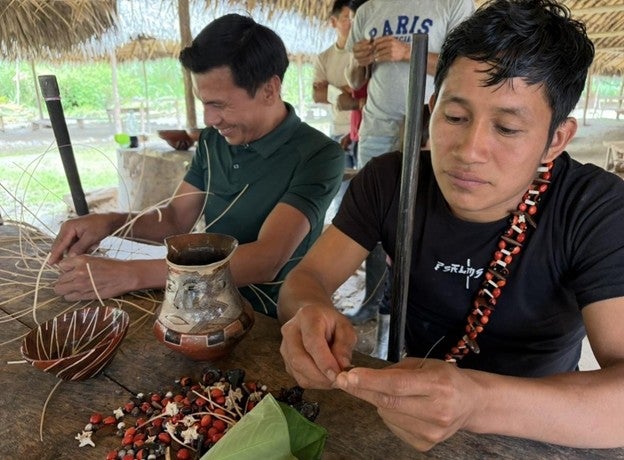
Pakayaku community members make traditional jewelry.
The Legal Front
From his office in Cuenca, environmental lawyer David Fajardo watches the Noboa administration’s assault on Indigenous rights with a trained eye. He has spent years defending constitutional protections that are now under systematic attack. As a specialist in rights of nature and collective rights working with Kuska Estudio Juridico, Cabildo por El Agua de Cuenca, and Yasunidos Cuenca, Fajardo represents the legal resistance movement that communities like Pakayaku increasingly depend on as government institutions fail them.
“Pakayaku is one of the main examples of how to fight extractivism here in Ecuador,” Fajardo explains, his voice carrying both admiration and urgency. “At the start of extractivist projects in their territory, they weren’t working with the projects. They had some agreements with oil companies, but then they realized that extractivism in their land would destroy not just their territory and their traditions, but also their spiritual way of life—everything they had reached and how they lived.”
What makes Pakayaku’s resistance so significant, according to Fajardo, is how they were able to succeed. “The government and the oil companies outnumbered them, but they managed to fight against these monstrous enemies and reached agreements aligned with their vision of territory, aligned with their vision of life itself.”
This success story becomes even more crucial in the current legal landscape under Noboa’s administration. “Right now we are facing a very hard situation because the economic interests, like Noboa’s family, are reorganizing around extractivism, especially mining extractivism,” Fajardo says. “They’re trying to reorganize the Ecuadorian state so they can manage all the mining projects here in Ecuador. They don’t care about the people. They don’t care about nature. They only care about the market.”
The systemic nature of this restructuring alarms Fajardo most. “Now the mining companies have all the support from the state, from the police, from the army. They don’t even care about the constitution, about the laws, about human and nature’s rights. If they have to destroy a community or move a community from their own territory, they are going to do this.”
Fajardo’s analysis reveals the depth of institutional capture under Noboa’s rule. “He controls the National Assembly, so all the laws right now are [made] by Daniel Noboa. He controls the electoral council so he can do whatever he wants with elections. He’s trying to control the justice administration. And now he’s trying to control the constitutional court because that’s the last problem he faces to have absolute control of the state.”
Behind this consolidation of power, Fajardo sees a clear motive: “He wants to have control of mining in Ecuador because he understands very well that previous presidents were trying to develop oil or mining production, and he wants to control it all for himself and his family. He’s a dictator, really.”
Despite this grim assessment, Fajardo hasn’t lost hope. Indigenous communities and their legal allies have developed sophisticated resistance strategies that go far beyond traditional litigation. “The most important strategy is to fortify the Indigenous organization,” he says. “That means connecting with other organizations, building a network for the defense of territory and collective rights.”
The legal strategy, which Fajardo calls “strategic litigation,” combines constitutional challenges with broader organizing. “We use protection actions and precautionary measures, but around the main case we also build a communication strategy and pressure for administrative decisions,” he explains. Communities are also leveraging social media to expose government and military incursions into their territories, creating international solidarity networks that amplify their resistance.
For communities like Pakayaku, this legal framework provides crucial tools for defending their territories even as the government systematically dismantles environmental protections. “Indigenous territories conserve nature more effectively than the government in Ecuadorian territories,” Fajardo says. “That’s a fact you can verify.”
This conservation success stems from what Fajardo describes as “a fight between two paradigms—the paradigm of life, to live with all the beings that exist in that territory, versus the capitalist paradigm, which believes the Earth, the animals, the plants are just objects you can sacrifice.”
As Pakayaku prepares to face new threats from government road projects and extractive concessions, Fajardo’s work in Cuenca represents the broader legal resistance that Indigenous communities increasingly rely on. His recent formal complaint to the Ontario Securities Commission against Dundee Metals—the Canadian company behind the controversial Loma Larga mining project near Cuenca—demonstrates how local resistance movements are taking their fights to international venues.
“Not everything is lost,” Fajardo insists, his voice gaining strength. “We continue giving the fight, and I’m pretty sure that at the end of the day, we are going to win this fight and save our territories for all the people and all the beings that live here right now.”
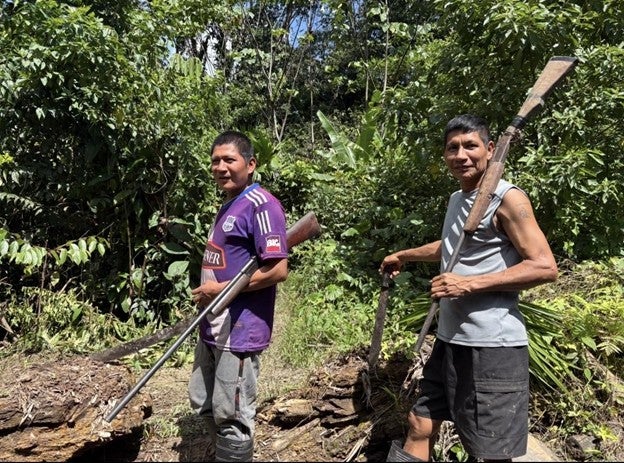
Pakayaku warriors, including Olger Manya (right), patrol their territory.
The Guardians
When threats arise in the territory, whether from illegal miners, unauthorized researchers, or government officials, the Pakayaku land guardians mobilize. Both men and women land defenders are trained to patrol their lands, as well as capture any uninvited guests. Olger Manya, a 46-year-old warrior and father of 7, is an experienced hunter and land defender.
“We have captured people involved in the provincial governance because they have not made good on what they promised to us,” Manya says. “Until they sign agreements [with us], we hold them. Only when they sign do we release them.” This system of enforcement extends to all levels of intrusion, from individual trespassers to government officials who fail to honor their commitments to the community.
Every three months, these guards organize extensive patrols of their borderlands, spending up to a month in the forest living off the land as their ancestors did. For Manya, this represents a continuation of practices that have sustained his people throughout their history. “In order to live, we hunt and we fish as our parents and grandparents did. I have been doing this all my life,” he says.
Manya’s hunting prowess has earned him respect throughout the community—including the rare privilege of possessing jaguar teeth, a trophy from an unexpected encounter deep in the forest. “I was not searching for a jaguar. It just appeared by chance, so I took advantage of the moment,” he recalls. Such encounters are extraordinarily rare, making his success a particular source of pride and establishing his reputation as a skilled hunter.
But hunting in Pakayaku involves more than skill with weapons. “I’m not hunting just because I need to hunt,” Manya explains. “You need to first have a dream. In this dream, you get the call. And in that moment, you go hunt.”
This spiritual dimension of forest life reveals itself most clearly in Pakayaku’s guayusa ceremonies, held in the early morning darkness before sunrise. Community members gather in circles around flickering fires, sharing steaming bowls of the sacred tea brewed from forest plants. In these intimate moments, they share and interpret their dreams from the night before—visions that determine whether the day will bring hunting and fishing or require staying close to home. Good dreams grant permission to venture into the forest, while bad dreams serve as warnings to remain in the safety of the community. The symbolism runs deep: dreaming of a jaguar means the dreamer will soon encounter someone who is upset, angry, and wise—a reminder that even in sleep, the forest speaks to those who know how to listen. This spiritual dimension connects the practical work of territorial defense to deeper cosmological understanding of their relationship with the land.
When asked why he protects Pakayaku with such dedication, the warrior’s answer is simple and profound: “Because I am a son of this land. I was raised here. I was born here. That’s the reason why I will defend this land—I’m defending my land.” The pristine nature of their territory motivates this defense. “Here, as you can see, there’s no contamination. That’s the reason why we preserve it.”
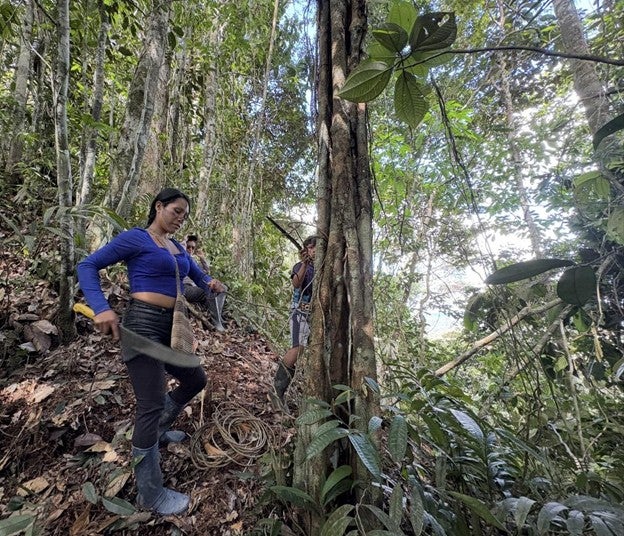
Gracia Malaover, the captain of the female Indigenous guards in the Pakayaku jungle.
Remaining Hidden, Staying Strong
As our canoe disappears back downstream toward the port that connects Pakayaku to the outside world, the community settles once again into its rhythm of protective invisibility. But after visiting Pakayaku, it’s clear that the sophisticated network of resistance there extends far beyond their remote territory, encompassing legal advocates like Fajardo, international solidarity networks, and strategic alliances with other Indigenous communities facing similar threats.
The philosophy of being “hidden people” that has protected Pakayaku for generations now faces its greatest test. As the Noboa government systematically dismantles environmental protections while accelerating extractive projects across Ecuador, communities like Pakayaku must balance their traditional invisibility with the need to make their voices heard in national and international forums.
Pakayaku demonstrates that Indigenous sovereignty requires both deep rootedness in tradition and strategic adaptation to contemporary threats. Yasacama’s decision to return from national leadership to grassroots organizing reflects this understanding—that the most powerful resistance often begins in the most remote places.
As Ecuador’s government continues its assault on Indigenous rights and environmental protections, the hidden people of Pakayaku offer a different model of survival: one that proves that some things remain beyond the reach of those who would exploit them. Their invisibility is not weakness but strategy, their remoteness not isolation but protection, their resistance not reactive but proactive.
In a world where Indigenous territories face unprecedented threats from extractive industries and authoritarian governments, Pakayaku’s story offers both inspiration and instruction. They demonstrate that defending territory requires more than legal documents or government recognition. It demands the kind of deep commitment that emerges only from generations of people who understand that their identity, their culture, and their future are inseparable from the land itself.
The mist that often shrouds Pakayaku territory serves as both literal and metaphorical protection, allowing them to remain hidden from those who would destroy while becoming visible to those who would defend. Their river still runs clean, their forest still stands intact, and their children still learn the names of plants and animals that outsiders have forgotten. In an age of environmental destruction and cultural erasure, this represents more than resistance—it represents hope itself, flowing like the Bobonaza River through territory that remains, against all odds, free.
—Brandi Morin (Cree/Iroquois/French) is an award-winning journalist reporting on human rights issues from an Indigenous perspective.
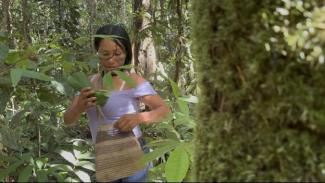
Top photo: Gracia Malaover, the captain of the female Indigenous guards in Pakayaku gathers medicine in the Pakayaku jungle.
function readCaptions(id){ var el = document.getElementById(id + '-captions'); if (!el) return []; try { return JSON.parse((el.textContent || '').trim() || '[]'); } catch(e){ return []; } } // Supports array OR object. For object, keys are "1", "2", ... (1-based) function capFor(caps, idx){ return Array.isArray(caps) ? (caps[idx] || '') : (caps[String(idx+1)] || ''); }
function buildImages(start, end, caps){ var list = []; for (var n = start; n <= end; n++){ list.push({ src: BASE + PREFIX + n + '.jpg', alt: 'Pakayaku ' + n, cap: capFor(caps, n - start) // 0..N-1 within this slideshow }); } return list; } function buildImageCarousel(rootId, images){ var root = document.getElementById(rootId); if(!root) return; root.innerHTML = '
- ' +
'
' +
'' +
'' +
'Previous' +
'' +
'' +
'' +
'Next' +
'';
var inner = root.querySelector('.carousel-inner');
var dots = root.querySelector('.carousel-indicators');
images.forEach(function(img, i){
var item = document.createElement('div');
item.className = 'item carousel-item' + (i===0 ? ' active' : '');
var fig = document.createElement('figure'); fig.className = 'Pakayaku-figure';
var frame = document.createElement('div'); frame.className = 'Pakayaku-frame';
var im = document.createElement('img');
im.src = img.src; im.alt = img.alt; im.className = 'img-responsive';
frame.appendChild(im);
var cap = document.createElement('figcaption');
cap.className = 'Pakayaku-cap';
cap.textContent = img.cap || '';
fig.appendChild(frame);
fig.appendChild(cap);
item.appendChild(fig);
inner.appendChild(item);
var li = document.createElement('li');
li.setAttribute('data-target', '#'+rootId); // Bootstrap 3
li.setAttribute('data-slide-to', i);
li.setAttribute('data-bs-target', '#'+rootId); // Bootstrap 5
li.setAttribute('data-bs-slide-to', i);
if (i===0) li.className = 'active';
dots.appendChild(li);
});
root.classList.remove('hidden');
// Bootstrap 5 → Bootstrap 3 → vanilla fallback
if (window.bootstrap && bootstrap.Carousel){
new bootstrap.Carousel(root, { interval: 6000, pause: 'hover', wrap: true });
} else if (window.jQuery && jQuery(root).carousel){
jQuery(root).carousel({ interval: 6000, pause: 'hover', wrap: true });
} else {
var items = [].slice.call(inner.children);
var idx = 0;
function show(i){
items[idx].classList.remove('active'); dots.children[idx].classList.remove('active');
idx = (i + items.length) % items.length;
items[idx].classList.add('active'); dots.children[idx].classList.add('active');
}
var timer = setInterval(function(){ show(idx+1); }, 6000);
root.querySelector('.carousel-control-prev').addEventListener('click', function(e){ e.preventDefault(); show(idx-1); });
root.querySelector('.carousel-control-next').addEventListener('click', function(e){ e.preventDefault(); show(idx+1); });
dots.addEventListener('click', function(e){
var li = e.target.closest('li'); if (!li) return;
var i = [].indexOf.call(dots.children, li);
if (i > -1) show(i);
});
root.addEventListener('mouseenter', function(){ clearInterval(timer); });
root.addEventListener('mouseleave', function(){ timer = setInterval(function(){ show(idx+1); }, 6000); });
}
}
// Build both slideshows
buildImageCarousel('gp-Pakayaku-1', buildImages(1, 13, readCaptions('gp-Pakayaku-1')));
buildImageCarousel('gp-Pakayaku-2', buildImages(14, 39, readCaptions('gp-Pakayaku-2')));
})();