
Duodji Diplomacy: Beaska Niillas on the Art of Politics (and the Politics of Art)
26 Mei 2026agnes
By Cristina Verán
During the most recent edition of Greenland’s annual Suialaa Arts Festival, the city of Nuuk was host to the “Sámi Embassy” (Lávvustallan), a work representing, at once, contemporary public installation art, scaled-up traditional craftsmanship, and Indigenous diplomacy in action. Through this piece, the vision of Beaska Niillas (Sámi) illustrates how ancestral foundations can forge new tools and alliances among nations.
For him, traditional and contemporary Sámi art forms have great value not only as creative works and craftsmanship; they are a tactile language that transmits lineage in a tangible form, helping ensure community survival. Niillas’s career trajectory reflects this duality, from the blacksmith’s forge in his village of Deatnu to the halls of the Sámi Parliament. Whether representing his people at the United Nations, art festivals, and global stages, or even on the silver screen, his life and work remind his people—and celebrate the fact—that the tools and practices of their past remain vital to Sápmi’s self-determined political future.
Cristina Verán met with Beaska Niillas in Nuuk to discuss how, for him, the roles of maker and leader often intertwine.
Cristina Verán: Please tell us about your journey toward becoming a practitioner of the traditional arts of your people, and of those who helped first spark your interest.
Beaska Niillas: I’d always dreamed, since I was 10 years old or so, about becoming someone who makes duodji—traditional things, like handicrafts (we use the term now to also refer to the arts overall).
My neighbor in our village, an Elder named Ingvald, was a master craftsman and a big inspiration for me. People like him in small Sámi villages are very practical; they make the tools and things we need ourselves. From the first time I visited his workshop, I thought, “Ooh, I want to learn this.” I’d already heard many stories about my great-grandfather, a skilled blacksmith whose traditional knives were famous, and that legacy also inspired me to learn blacksmithing.
I chose to study at Sámi Joatkka ja Boazodoalloskuvla (in Guovdageaidnu) and at Sámij Åhpadusguovddásj (in Johkamohkki)—both on the Norwegian side of Sápmi. I then headed to Jokkmokk on the Swedish side for a two-year apprenticeship under a duodji master. I worked as a duojár (maker of duodji) for many years after that.
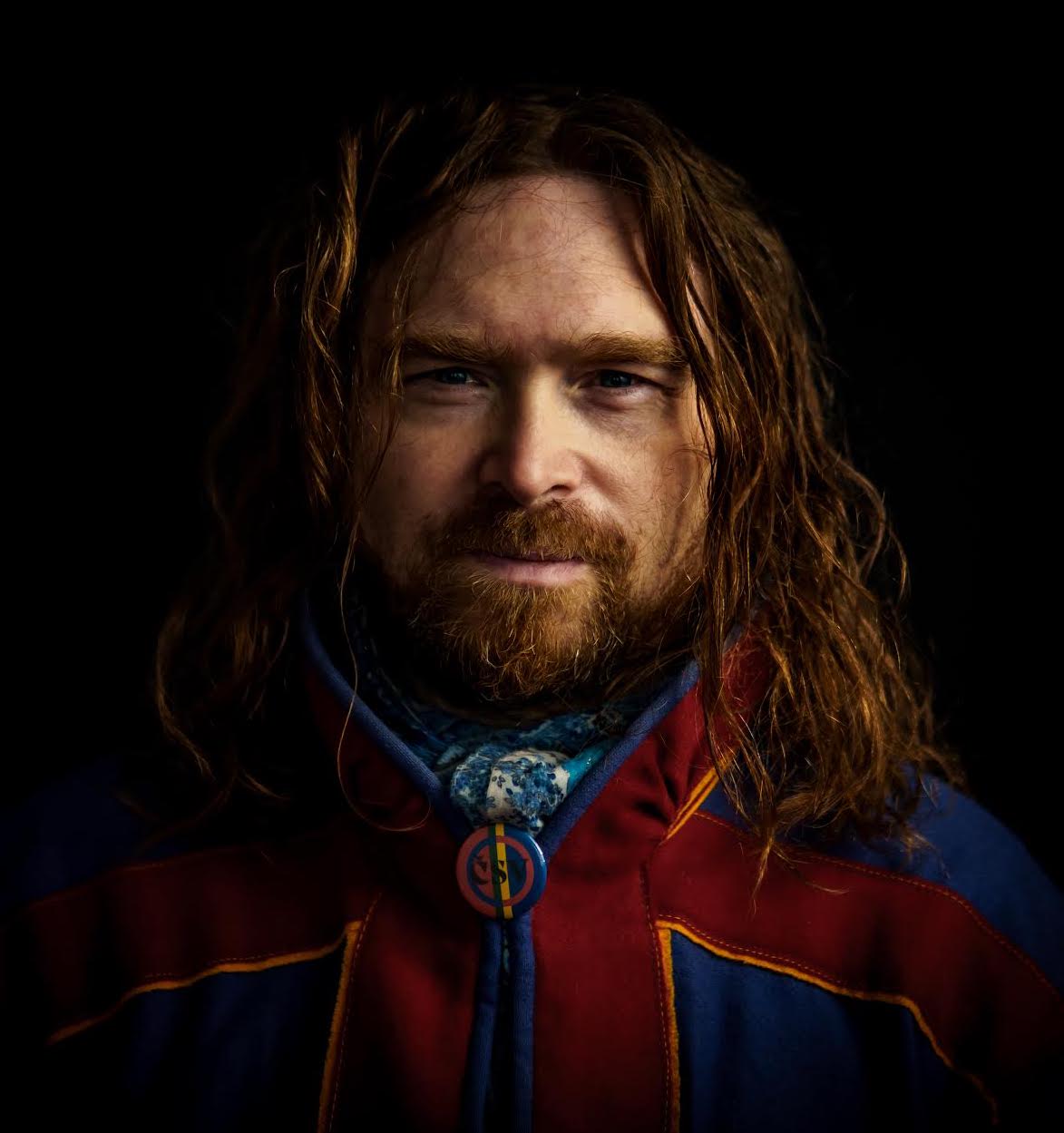
Beaska Niillas.
CV: In the beginning, was your focus more (or solely) from a sense of purpose, to further the continuation of those forms and objects or, through this artistic calling, did you also intend to address your economic needs?
BN: I wanted to make things that would sell well, of course; I needed money to live on. So I started with traditional Sámi knives and guksi (wooden cups made of birch burs). I continued learning how to make almost every other tool and craft of my ancestors—but there is still one thing I haven’t yet done: build a traditional Sámi boat.
CV: That seems like a massive undertaking, compared with the scale of knives and cups. What specifically goes into its construction—in terms of materials, form, and skills?
BN: Sámi boats have traditionally been constructed with wooden frames and planks that we would craft ourselves, covered in animal hides. While those of a reindeer can work, they aren’t quite strong enough for the task. It’s believed that our ancestors used moose hide instead; because the animal is much larger, it is easier to produce the large, durable pieces needed for a vessel of that size.
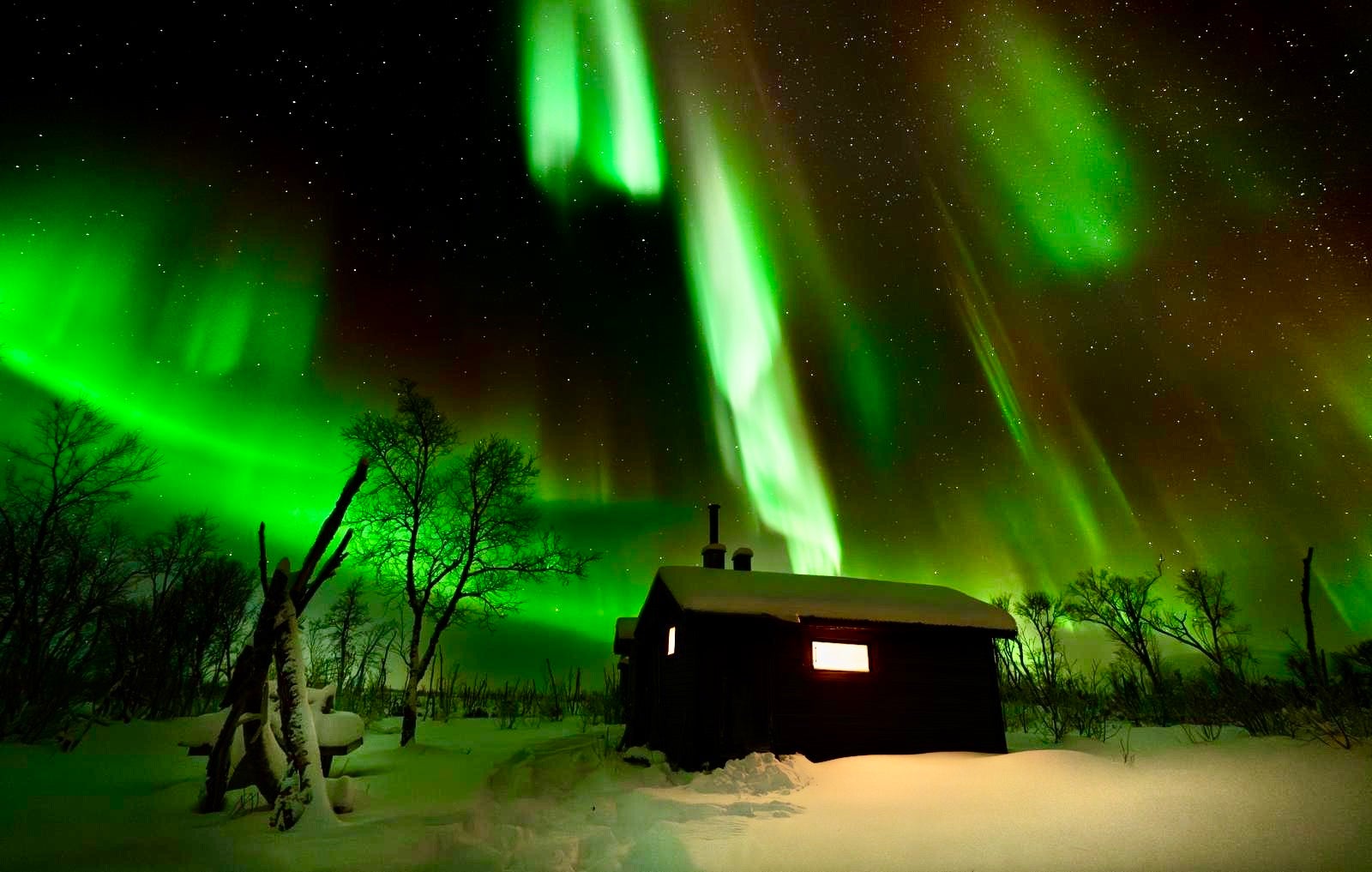
Beaska’s family cabin, used for hunting and gathering, in Sápmi.
CV: As you’ve continued these beloved traditions, have you also found ways to express your own ideas within them, using methods distinctly your own?
BN: I really like to experiment; for example, using old materials to make new things, or reimagining old things by incorporating new materials—including those that I’ll exchange with other Indigenous peoples I meet. In Canada, for example, I was once gifted a mammoth tooth—for which I traded a reindeer antler from Sápmi. Our communities have always been trading and sharing materials and ideas like this.
Furthermore, I enjoy incorporating materials commonly used by other Indigenous Peoples into something I’ll produce in a traditional Sámi way—and the other way around, as well. I’ll ask other Indigenous artists for permission to make a version of something from their art or craft practices, but using my own materials that are traditional for Sámi, instead. This, of course, depends on whether or not they give their consent.
CV: There is a clear contrast between the ethics of “consensual exchange” you prioritize, and the sort of extractive appropriation encountered in some state-led tourism in Sápmi, no?
BN: In Norway, fortunately, that’s not so common, but the type and the level of appropriation are particularly bad on the Finnish side of the border. A lot of entrepreneurs there just want to take from and exploit our Sámi culture without permission. Not only do they counterfeit and touristify almost every type of Sámi craft, but what they produce is ugly and of poor quality. Then when visitors see such things, they get a bad—and wrong—impression of Sámi culture and craftsmanship.
Fortunately, we now have a Sámi Duodji trademark—used across all of Sápmi—so that a person wanting to buy something authentic, made by our communities, can be sure it’s the real deal.
CV: This poor-quality counterfeiting of your cultural patrimony is, sadly, not the sole form of disrespect Sámi experience from mainstream society.
BN: There is a deep history of racism against our Peoples throughout Scandinavia. It was once—and not so long ago—very popular (for non-Sámis) to dress up in costumes and pretend they were drunk Sámi, acting foolish; treating such mockery as entertainment. To us, it is comparable to what we imagine African-Americans must feel about “blackface.”
CV: Your work life eventually expanded to engage in a number of political roles and endeavors. Was this supplementary, or directly linked to, your arts practice?
BN: My life’s project, in every realm that my work touches, is to preserve and revitalize Sámi culture—which includes our language, our crafts, our philosophy, and our skills. I wouldn’t say my art and my politics are explicitly connected, but the values and the foundation that inform my politics do come from my artistry. The western world wants to separate everything; you’re either this or you’re that. In an Indigenous worldview, however, everything is connected.
.jpg)
Beaska Niillas at the UN Permanent Forum on Indigenous Issues in 2024. Photo courtesy of UN Web TV.
CV: What experiences or issues drew you into the political arena?
BN: I didn’t really care about politics or know much about our Sámi political parties until I was nearly 30 years old. At the time, I’d been working as a translator, and attended a conference where the President of the Sámi Parliament gave a speech. As I listened to what he was saying, I thought to myself, “I would have spoken differently, were I in that position. Hmm… maybe I should participate in these things!” Thereafter, I did.
CV: In what such roles have you served thus far—governmental and otherwise?
BN: I’ve worn many hats! I was a Member of the Sámi Parliament for 12 years—which, unlike traditional forms of governance we once had, is a western style of parliamentarianism (state-recognized, with a democratically elected body), grounded in Indigenous values.
Now, I serve as a deputy member of the Saami Council (a non-governmental organization representing our people across Norway, Sweden, Finland, and Russia) and as vice chair of the NSR (the Norwegian Sámi Association, which is my NGO).
CV: What concerns have you prioritized through that work?
BN: Much of my time has gone to land-defending because, without land, we will lose our culture. Sámi are fortunate enough to still have a lot of it to live on, but it’s becoming less and less.
I’m also committed to fighting extractive industries in our territories. Norway—which likes to portray itself as one of “the good guys” with regard to Indigenous Peoples—is getting worse and worse on this issue. When Sámi bring our concerns to the Supreme Court, they ignore us. Even when we actually win a case there, that doesn’t force any real change. I feel like the Norwegian government showed Sámi more respect in the past. Now? They don’t even try.
CV: How have you found the arts to be useful, perhaps to help promote and educate others about both issues of importance and the histories from which they’ve emerged?
BN: Well, in the last decade or so, I started writing poetry as a way to help cope with a lot of things. I’ve also been acting in movies and in theater—including projects with a political focus. For example, one film, “The Kautokeino Rebellion” (Guovdageainnu Stuimmit), tells an important and true story from our Sámi struggle, set in 1852. Another, “Let the River Flow,” (Ellos Eatnu – La Elva Leve) depicts the conflict over the hydroelectric dam construction on the Alta River—the rebellion out of which the Sámi Parliament was born.
In a kind of crazy parallel reality, we took the same actions in real life back in 2021, during our resistance against Nussir ASA (a copper mine planning to destroy reindeer grazing lands and the Riehpovuotna Fjord) and the already existing Fosen wind turbines (which have destroyed critical pastures and scared our herds away).
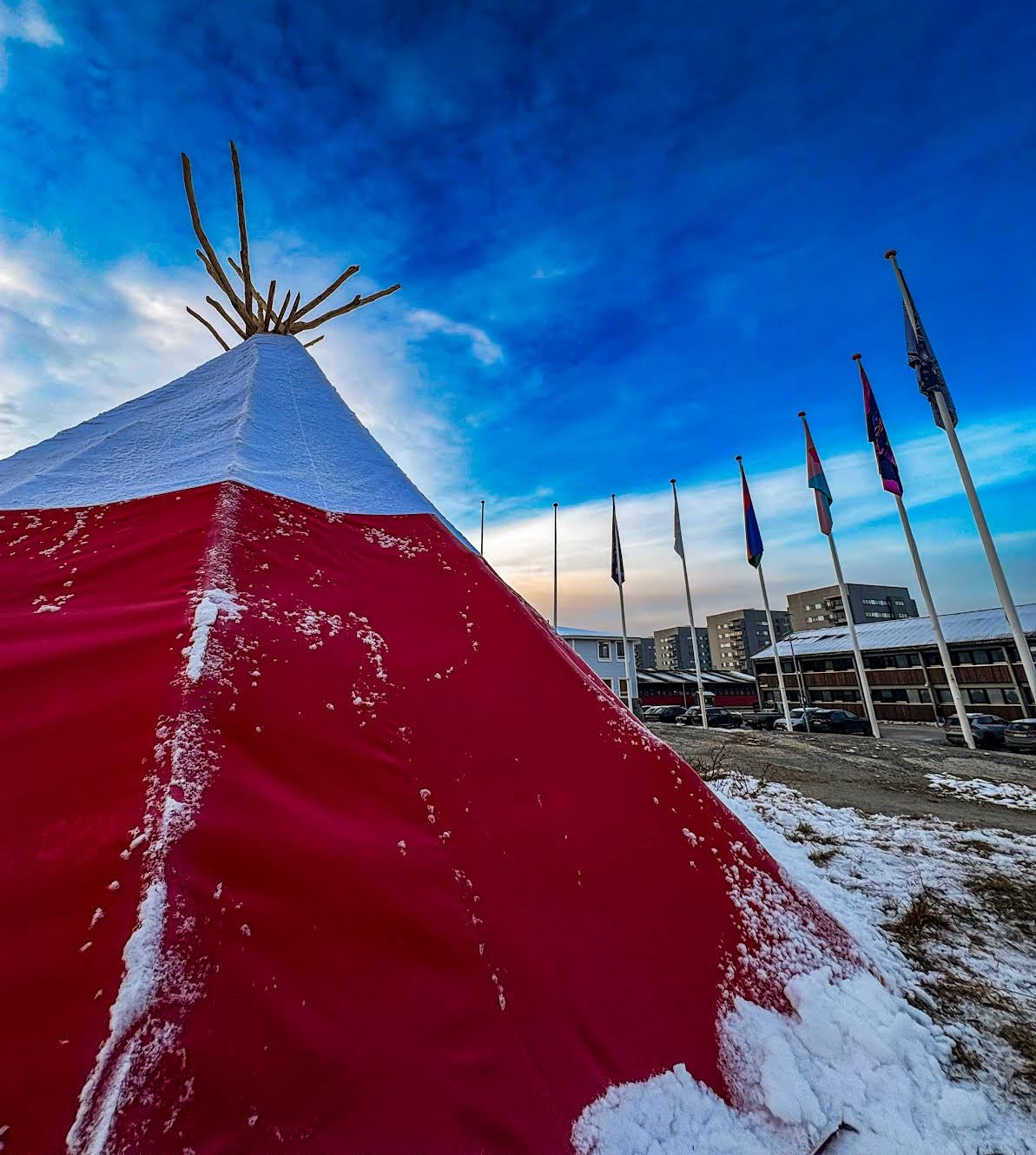
View of the lávvu.
CV: Your Sámi Embassy Project—which served as both a focal and gathering point across from Katuaq Cultural Centre in Nuuk, during the Suialaa Arts Festival—seems like an intuitive synthesis of your artistic and political work. Where did the spark or precedent for this idea come from?
BN: I’ve been to Greenland many times, and I remember, during a prior visit, walking by an embassy from another country down one of the main streets in the capital, and passing. That’s when the idea popped up: Sápmi really should have an embassy here, too. Inuit and Sámi have long worked together—like sister Peoples—on a political level, an art level, and a personal level, too.
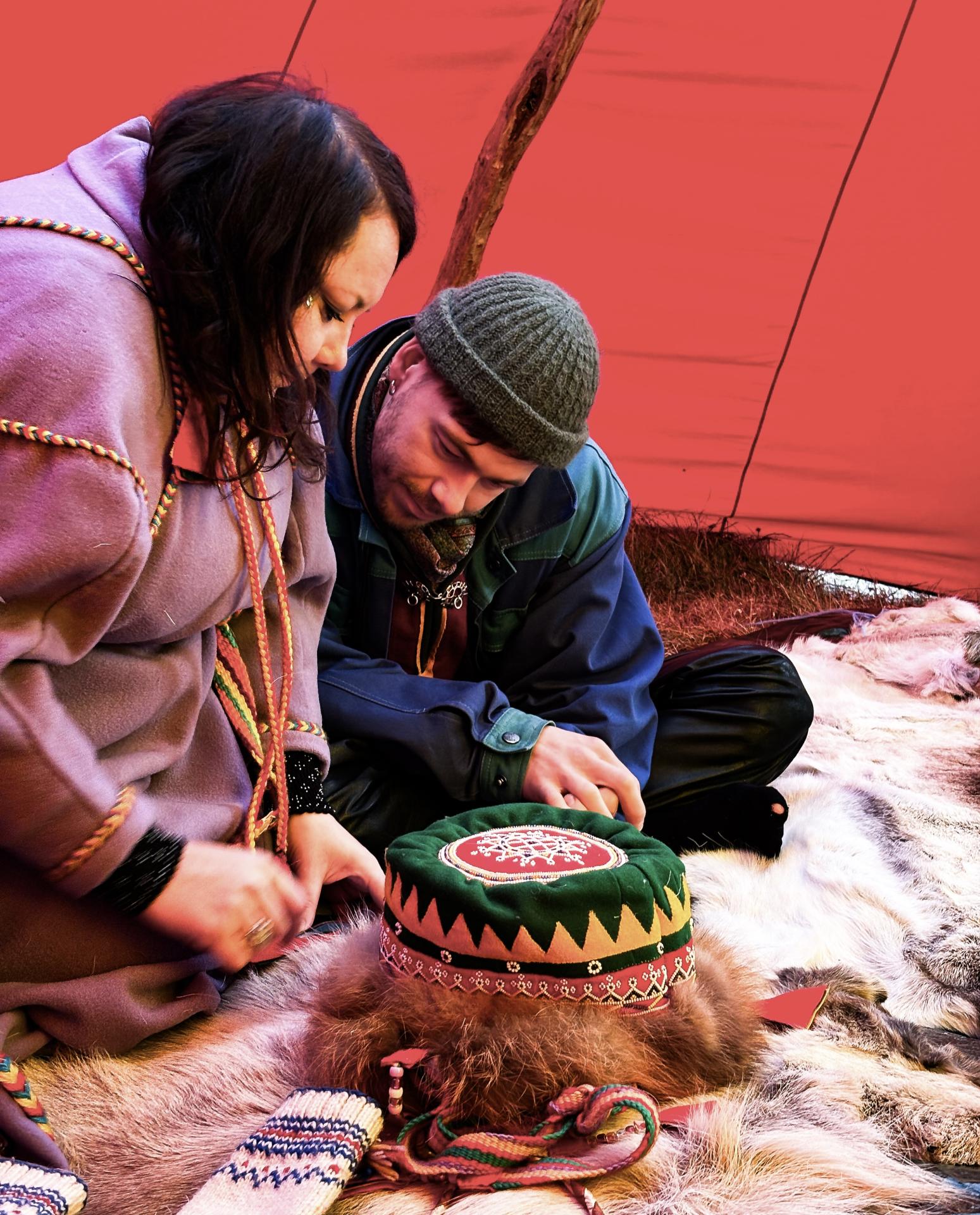
Visitors inside the Sámi Embassy.
CV: The term “embassy” implies and evokes a relationship to statecraft. What forms of diplomacy did Sámi engage in before the modern Scandinavian states came into being?
BN: Before those states claimed dominion over our lands, Sámi had our own kind of diplomats who engaged in trade and treaty-based diplomacy with others we encountered, from the early czars of Russia to the Vikings. Without diplomacy between us, things could have otherwise been really bad. That history, of always striving to be in relationship with our neighbors, is the grounding for this Sámi Embassy project.

The ceiling of the Sámi Embassy in Nuuk.
CV: Is it intended as both a political and an art space at once? From where did you draw inspiration for the physical form and design of the installation?
BN: I considered doing this specifically as a political activation, but then decided it should be an art project, too. The mission became this: to create a mobile embassy structure that would be easy to set up and take down, from the philosophy that one should leave the land as one finds it. Instead of some fixed office space, then, I thought it should have our own Sámi style of structure—a lávvu—in which our Peoples can meet, nation to nation.
The canvas cover of the structure is designed in two detachable halves: one painted in the colors of the Sámi flag and the other in those of the Greenlandic flag. When the festival came to an end, I left the Greenlandic half and the lávvu poles behind and packed up the Sámi piece to bring back home. Now, whenever Greenlanders come on official visits to Sápmi, they can bring their piece to reunite it with ours and recreate the embassy all over again.

CV: Given that Denmark remains in charge of “foreign relations” regarding Greenland, did it factor into the protocols by which you felt important for the Sámi Embassy to abide?
BN: To be clear, I did not—and would never—go to Denmark for “permission” to be here. Instead, a different protocol is required: to seek and receive permission not only from the Indigenous Peoples to whom the land the Embassy will sit on belongs, but from the land itself.
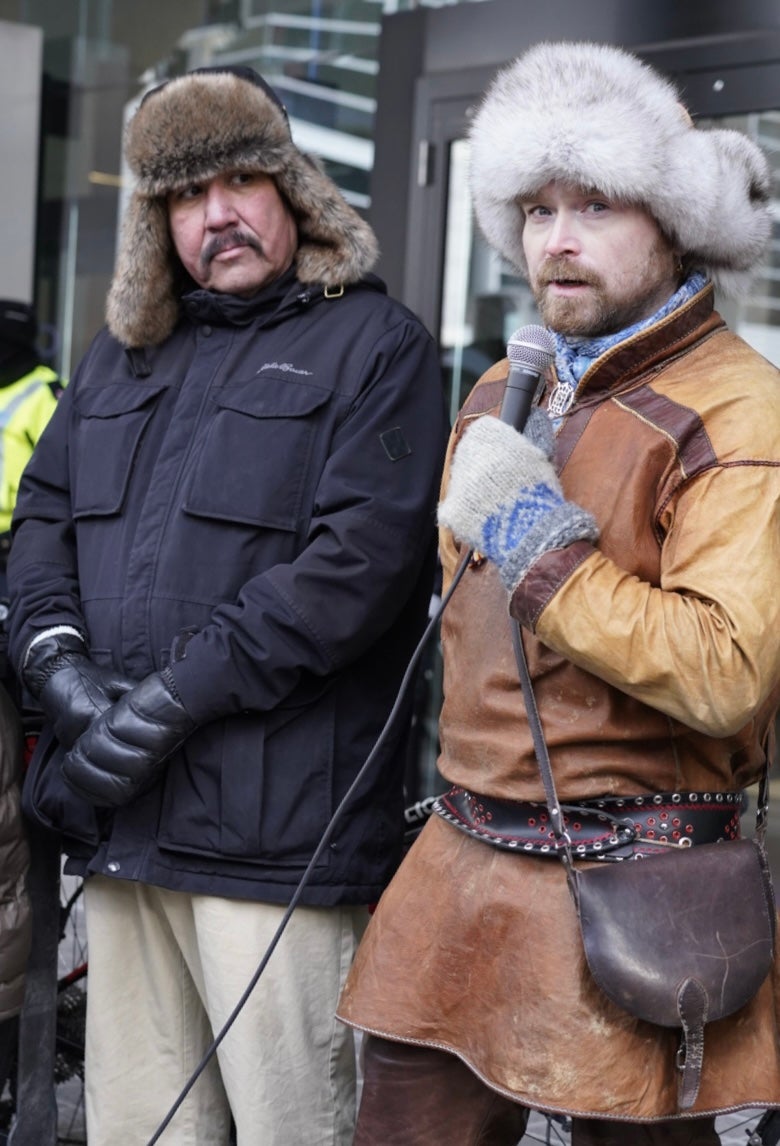
Beaska Niillas in Toronto with Climate activist Clayton Thomas-Muller (Cree) in Toronto, 2025.
CV: You’ve brought a lávvu to other places, including in North America, for other occasions before. What is it like to inhabit what is, firstly, a Sámi space as it visits lands far from home?
BN: Wherever you put it up, it feels like home, even in the center of a big city. Once you close its entryway, you are in a very safe space, and the sounds of the world fade away. Of course, to be truly comfortable in it, as I’ve noted, requires consent from the land.
CV: Finally, you mentioned having been a translator. Is there a specific value or concept that the Sámi language best captures regarding the current struggle for and future of your people?
BN: “Birget” is a word and concept in my culture that’s very important to me, and difficult to translate exactly. It relates to how we should live in this world; how to survive and thrive in it, with resilience and self-sufficiency. That’s not easy to do in Sápmi, given its arctic climate and landscape. I was fortunate enough to have been raised by my grandparents, on our land and with their values, in effect, jumping one generation back—learning about birget directly from my grandfather. I’m really privileged to have had that all passed on to me, and I hope to do the same for the generations to follow.
*Special thanks to Visit Greenland for its gracious assistance in facilitating travel, access, and local coordination in support of this reporting project.
–Cristina Verán is an international Indigenous Peoples-focused researcher, educator, advocacy strategist, network weaver, and mediamaker. She was a founding member of the United Nations Indigenous Media Network and the Indigenous Language Caucus. As Adjunct Faculty at New York University’s Tisch School of the Arts, she brings emphasis to the global histories, expressions, and socio-political impacts of Indigenous contemporary visual and performing arts, design, and popular culture(s).
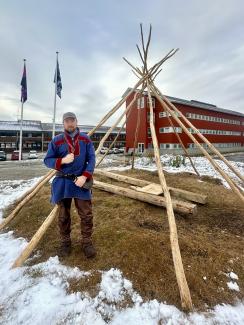
Top photo: Packing up the Sámi Embassy lavvú to return home, with Inatsisartut (the Parliament of Greenland) offices in the background. Photo by Cristina Verán.
All photos courtesy of Beaska Niillas.