
What Hungary’s New Pro-Democracy Government Means For Rule of Law
 13 Mei 2026
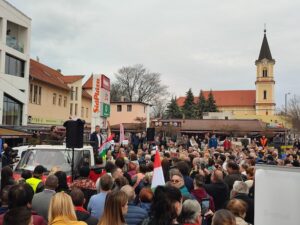
Tisza Party Leader Péter Magyar speaks to a crowd of supporters in Siófok, a town in Somogy County, southwestern Hungary, after leading a landslide election victory in April. Credit: SNRTZ
By Catherine Wilson
SYDNEY, Australia, May 13 2026 (IPS)
Péter Magyar, leader of the pro-democratic centre-right Tisza Party, which recently swept into power on an unstoppable wave of hope for change, has now been sworn into office as Hungary’s new Prime Minister.
After a decade and a half of increasing authoritarian governance by the former Fidesz regime, led by Prime Minister Viktor Orbán, the pro-democracy movement in the central European nation delivered a democratic rebound at the general election held on 12 April.
“I will not rule over Hungary; I will serve my homeland,” the 45 year old Magyar pledged during the taking of the oath of office ceremony in the Hungarian parliament on 9 May. The formal beginning of a new era in the country was followed by a massive public festival dedicated to freedom and democracy in the streets of Budapest, Hungary’s capital. The celebration took place nearly a month after the Tisza Party leader stood in front of jubilant crowds as the election result became clear to declare, “Today the Hungarian people said yes to Europe. They said yes to a free Hungary.”
The new Tisza government, which secured a supermajority of 141 of 199 parliamentary seats, has promised a roll back of the democratic decline that occurred during the Orbán era. After being elected into power in 2010, the Fidesz regime steadily stifled opposition and dissent by manipulating the electoral system, eroding the independence of the judiciary and media, threatening government critics and undermining the work of civil society organisations.
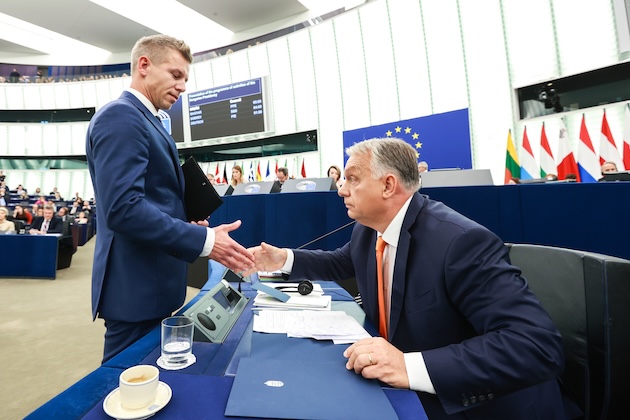
Péter Magyar (L), Leader of the Hungarian Tisza Party, and Viktor Orbán (R), Leader of the Fidesz Party, at a European Parliament Plenary Session in Brussels, 9 October 2024. Credit: European Union/Alain Rolland
“The election results have opened the door to exercising public power within appropriate constraints. Checks and balances may be revived, social participation can have a greater role, and the constant attacks against NGOS and the independent press may cease,” Gábor Medvegy at the Hungarian Civil Liberties Union in Budapest told IPS.
These were the expectations of many Hungarians 37 years ago, when the nation severed ties with its Communist past. Located west of Romania and south of Slovakia and Ukraine, Hungary lived under Soviet-aligned rule from 1947 to 1989 when it began the transition to a multi-party democracy. It then became a member of NATO in 1999 and the European Union (EU) in 2004.
But the next generation after this moment of immense political and social change witnessed the gradual loss, rather than gain, in democratic rights, as Orbán implemented policies in line with his vision of “illiberal democracy”. Four years ago, the European Parliament declared that Hungary had become an ‘electoral autocracy’ which undermined the rule of law, freedom of expression, religion and association while failing to address corruption. According to Transparency International, the nation has a poor corruption perception score of 40/100. And soon it was penalised for its autocratic tendencies when the EU withheld billions of euros in funding.
The possibility of a political alternative emerged two years ago when Magyar, who held positions in the Fidesz Government, resigned to join the opposition. He remains a deeply patriotic leader speaking to Hungarian interests, but he has also articulated a clear commitment to change. The Tisza Party’s manifesto, ‘A Functioning and Humane Hungary,’ outlines a vision of accountable governance, return to the rule of law, the independence of the judiciary and media and a renewed fight against corruption, while also improving public services and addressing the cost of living and rural disadvantage. At present the nation’s public spending on health is about half the EU average and its preventable mortality rate of 333 per 100,000 people is well above the EU average of 168, reports the European Commission.
The party’s focus on core voter concerns and strong policies is likely to have been a factor in the high voter turnout of 77 percent and strong youth participation in the April poll. An estimated 30 percent of the country’s population of 9.7 million people are aged under 30 years, and media reports claim that 65 percent of voters in this age group were Tisza supporters.
And the new government has made a rapid start on its policy promises. Negotiations with the EU have begun to re-establish democratic norms in Hungary and secure the release of the withheld funding. “What is important is the economic development in Hungary,” Dr Anton Shekhovtsov, Visiting Professor at the Central European University in Vienna, told IPS. “If Magyar is able to de-block the EU funding that was withheld for a few years now, the economic situation will hopefully improve.” It will also be important to enable Hungarian industries to thrive in order to boost the domestic economy, he added.
But, to achieve this, the new government will have to address nepotism in state institutions and key public office posts. “Essentially Hungary, under Orbán, is a captured state. The power of Fidesz has penetrated state institutions very deeply. So the task for Tisza is now to drain the swamp, get rid of the deep state,” Shekhovtsov emphasised.
Democracy more widely in Europe could also benefit from the influence of Hungary’s new leadership. The EU’s support of Ukraine, following the Russian invasion in 2022, was impeded by the Fidesz government’s repeated alignment with Russian President Vladimir Putin. Orbán opposed the bloc’s Russian sanctions and, in February, vetoed a critical 90 billion euro loan to Ukraine after a damaged pipeline halted the supply of oil from Russia. However, Hungary lifted its veto by 23 April, with oil flows resuming, and approved the EU’s next round of sanctions on Russia.
“Unlike Orbán, Magyar has no ties to Russia and, therefore, his government will not be subordinated to Moscow and its interests,” Bálint Madlovics, research fellow at the Central European University in Budapest, told IPS. He has also “clearly framed Ukraine as a victim of aggression, strongly opposing any external pressure on Kyiv to cede territory”.
However, on migration, another regional issue, Hungary’s new prime minister made it clear in the months before the election that he opposes illegal migration and intends to maintain the southern border fence which was constructed in 2015 to prevent unauthorised migrants from entering the country. Although Hungary may need to alter its stance when the EU’s new migration and asylum agreement, which requires member states to contribute to the regional responsibility for managing refugees, is implemented in June.
Yet, arguably, the new government has, in a short time, begun to build confidence with its own people and with other European nations that are committed to a democratic region. In the long term, strengthening civic rights and liberties and improving equality are crucial for the new Hungary, Medvegy said. And “we must help ensure that people are not merely spectators of politics but active participants,” he emphasised.
IPS UN Bureau Report