Uganda Announces End of Ebola Outbreak, Yet Regional Risks Remain
 28 Agustus 2026
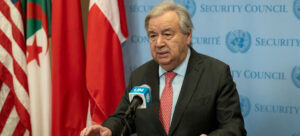
UN Secretary-General António Guterres (at podium) briefs reporters on the status of the Ebola virus outbreak. Credit: UN Photo/Mark Garten
By Shreya Komar
UNITED NATIONS, Aug 28 2026 (IPS)
Following 42 consecutive days without a new confirmed case, The Africa Centres for Disease Control and Prevention (Africa CDC) and the World Health Organization (WHO) have announced the end of the Ebola outbreak in Uganda.
The outbreak began in the Democratic Republic of the Congo (DRC) and Uganda in May and was caused by a rare strain of the Ebola virus known as the Bundibugyo species. There are no approved vaccines or therapeutics against the Bundibugyo strain, though several are currently being trialed in the DRC, Canada, and the United Kingdom. The virus is highly contagious and can still be transmitted after an infected person has died.
Uganda’s last patient, whose infection was imported, was discharged from care on 16 July 2026, and no new cases have been reported since.
“Uganda has shown that Ebola can be stopped when leadership acts decisively, communities are trusted and public health systems reach people quickly,” said H.E. Dr Jean Kaseya, Director-General of Africa CDC.
“The outbreak is the fastest-growing Ebola epidemic on record. It is growing faster and wider than the response to contain it. But it can be stopped,” said UN Secretary-General António Guterres during a press stakeout on August 27. Guterres referenced the recently-appointed UN Senior Ebola Coordinator, Julien Harneis, who is working with regional partners to strengthen community engagement, surveillance, treatment, safe burials and measures to contain the virus. The UN is also reinforcing preparedness and coordination with South Sudan and the Central African Republic to prevent further cross-border transmission.
Additionally, to address the challenge of limited health infrastructure and laboratory services, the WHO, with funding support from the African Development Bank (AfDB), has handed over a Truck-Mounted Mobile Biosafety Level 3 Laboratory to the Government of Uganda in efforts to strengthen Uganda’s public health response capacity and support post-outbreak preparedness.
The mobile laboratory will support rapid, field-based diagnostic testing during outbreaks, reducing the time required to transport samples to centralized testing facilities and accelerating public health decision-making. The laboratory is expected to improve access to testing in hard-to-reach areas and at outbreak epicenters, where timely diagnosis is critical to containing disease transmission.
Contrary to Uganda, in the DRC, the devastation of the Ebola outbreak continues to what has now become the country’s deadliest public health crisis. As of August 25th, 5,713 cases have been confirmed, claiming 2,744 lives. About 500 new cases are being reported every week, with women and children being severely affected.
Emmanuel Kalinde, Child Protection Manager in Ituri, said the crisis had upended children’s lives, leaving many to grieve loved ones while facing conflict and displacement. He stressed that sustained support was essential to help them heal and regain hope.
The WHO continues to advise against travel and trade restrictions related to Ebola outbreaks. However, despite potential risks, they do not recommend suspending flights, closing borders, or denying entry to travellers from affected countries.
IPS UN Bureau Report

