
Austerity and Privatization Weakened OECD Education Systems
 5 Oktober 2026
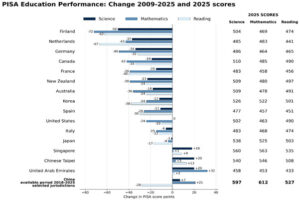
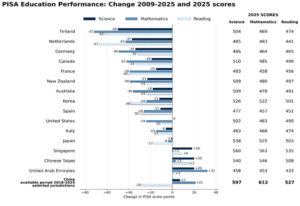
OECD PISA education performance: change in scores between 2009 to 2025, and 2025 scores.
By Isabel Ortiz and Antonia Wulff
BRUSSELS / GENEVA, Oct 5 2026 (IPS)
The results of the OECD PISA 2025 report point to the marked deterioration of results in countries whose education systems were once considered exemplary. PISA assesses how students aged 15 apply skills in reading, mathematics, and science to real-life situations, and the latest report contains the lowest averages ever measured in all three subjects across the OECD (as illustrated in the graph above). Public debate has rushed to blame the use of AI and social media, but the deterioration long predates them. In many countries, this decline has unfolded alongside years of austerity cuts and growing pressures on public education systems, including public spending, teacher pay and working conditions, staffing and the capacity of schools to provide quality education.

Isabel Ortiz
These austerity cuts and cost-containment reforms started after the 2008 financial crisis, when governments mobilized emergency support for the financial sector, in loans, capital and guarantees, equivalent to around half of national income in the advanced G20 economies. This unprecedented bailout left public treasuries depleted, and the costs of adjustment were then thrust upon populations: from 2010, governments turned to austerity reforms or fiscal consolidation, cutting education budgets alongside other public services.
Austerity reforms in education include reduced public budgets, wage restraint for teachers and school staff, recruitment freezes, staff reductions, heavier workloads, and the privatization and commercialization of education. Fiscal consolidation led half of OECD countries to cut or freeze teachers’ salaries after 2010; between 2008 and 2012 teachers’ real wages fell in 16 of the 30 countries for which data is available, and by more than a quarter in Greece. Finland cut 1.5 billion euros from education during 2011 to 2018, and – among many other damaging cuts – closed and merged schools. In the United States, spending per pupil fell roughly 7% after the financial crisis, and rigorous research shows these cuts lowered test scores and college attendance.

Antonia Wulff
The teaching profession has not recovered. In 13 OECD countries and economies, primary teachers were earning less in real terms in 2024 than in 2015. The share of students in schools whose principals report that teacher shortages hinder instruction jumped from 26% in 2018 to 47% in 2022, and stood at around 40% in the 2025 assessment. This trend was concentrated in public schools, including those that serve disadvantaged populations. The latest data shows the continuing scale of the problem – only 28.8% of OECD students study in schools where principals reported no teacher shortages. The OECD’s own teacher survey finds that 17% of teachers intend to leave the profession within five years, rising to around half of young teachers in some European countries. Globally, 44 million additional teachers are needed in primary and secondary education alone by 2030, more than half of them simply to replace teachers leaving the workforce.
Privatization and commercialization compound the damage. More than 350 million primary and secondary students worldwide are enrolled in private institutions, and the enrolment share of government-funded private schools has risen since 2000 in many countries. UNESCO’s global review is blunt: the apparent superior performance of private schools is largely attributable to the socio-economic advantages of the student population.
These trends reflect political choices: what governments choose to fund and what they choose to cut. When education systems are asked to do more with less, the consequences are felt in classrooms. Fewer teachers, heavier workloads, weaker pay and conditions, and less capacity to provide every child with a quality public education. The question is not whether we can afford to reverse this decline but whether governments are prepared to prioritize the investment that public education requires.
The money was never missing, it is a question of priorities. Governments mobilized US$10 trillion to rescue banks in 2009, and in the four years since the invasion of Ukraine, the world has spent more than $10 trillion on the military, with NATO members each pledging to spend 5% of GDP on this by 2035, exceeding the share that most devote to education. Today, debt-service payments exceed education expenditure in Colombia, Costa Rica, Hungary, Mexico, Poland and Türkiye, among other countries, meaning again that governments are prioritizing paying off private creditors, banks and defense over children. New revenues are within reach: from progressive taxation, taxing windfall profits (e.g. from oil) to a 2% minimum tax on the wealth of billionaires which would raise $2.5 trillion over a decade. The G20 has, meanwhile, already committed to cooperating on taxing the super-rich.
Austerity was a policy choice and so are public services for people’s prosperity. Through sustained investment in public education, decent pay for qualified teachers, and equitable learning conditions, OECD countries could once again set the example and invest in educating their children to expand opportunity for the next generation.
Isabel Ortiz, Director, Global Social Justice, was Director at the International Labor Organization (ILO) and UNICEF, and a senior official at the UN and the Asian Development Bank.
Antonia Wulff, Director of Research, Policy, and Advocacy, Education International.
IPS UN Bureau



Excerpt:
Decline blamed on AI and social media but was triggered much earlier by austerity reforms and budget cuts.