
‘Africa Cannot Burn Its Way Out of Its Waste Crisis’, Zero-Waste Advocates Say at COP31
 13 November 2026

Members of the Global Alliance for Incinerator Alternatives (GAIA) gather at the COP31 climate summit, calling on governments to prioritise zero-waste solutions and methane reduction over waste-to-energy incineration in Antalya, Türkiye, on November 10, 2026. Credit: Nipe Fagio
By Chemtai Kirui
ANTALYA, Türkiye & NAIROBI, Nov 13 2026 (IPS)
Plans to build waste incineration plants across Africa risk undermining efforts to curb methane emissions, zero-waste campaigners have warned, as world leaders and climate negotiators gather in Antalya, Türkiye, for the COP31 climate summit.
Waste management and methane reduction are among the issues under discussion at the summit, with campaigners saying that governments should prioritise waste separation, composting and recycling over investment in incineration infrastructure.
Weyinmi Okotie, executive director of the Green Knowledge Foundation, said only 55% of municipal solid waste was collected across Africa, with just 4% recycled.
Organic material accounts for as much as 70% of municipal waste in some African cities, Okotie said, much of which ends up in dumpsites and landfills.
As it decomposes in oxygen-poor conditions, the waste releases methane, a greenhouse gas with about 80 times the warming potential of carbon dioxide over a 20-year period.
Food waste accounts for up to 14% of global methane emissions, according to a 2026 report by the UN Environment Programme
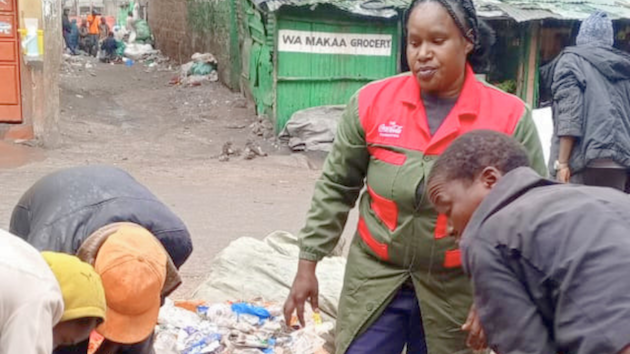
Mary Nyambura Kanyui at her recycling aggregation yard on Juja Road in Nairobi’s
Eastleigh area, where she buys recyclable materials from waste pickers. Credit: Chemtai Kirui/IPS
and UN-Habitat. The report estimated that 1.05bn tonnes of food were wasted in 2022, even as 783mn people faced hunger.
A ministerial declaration issued at COP31 by countries participating in the Global Methane Pledge called on governments to prevent organic waste from being sent to landfill, expand resource recovery, and capture methane emissions where avoidance is not yet possible.
The declaration reaffirmed the Global Methane Pledge‘s goal of cutting global methane emissions by at least 30 per cent below 2020 levels by 2030. It was endorsed by seven countries: Belgium, Canada, Germany, Indonesia, Norway, the UK and the Federated States of Micronesia.
The declaration was issued as ministers and private-sector representatives met to assess progress towards the target.
Existing commitments are projected to deliver only 10–11 per cent of the emissions reductions needed by 2030, participants warned, and they called for stronger policies, improved emissions monitoring, and increased public and private investment.
They called for stronger policies, improved emissions monitoring and greater investment to accelerate methane reductions across the energy, agriculture and waste sectors.
Global municipal solid waste is projected to rise from 2.1bn tonnes in 2023 to 3.8bn tonnes by 2050, according to the UN Environment Programme (UNEP). The annual cost of managing waste, including the effects of pollution, ill health and climate change, could reach US$640.3bn by then if current trends persist.
A shift towards a circular economy, in which materials are reused rather than discarded, could instead generate net annual economic gains of US$108.5bn by 2050, UNEP estimates.
Türkiye’s president, Recep Tayyip Erdoğan, urged governments to embrace zero-waste initiatives, saying efforts to reduce rubbish and increase recycling could help cut emissions and tackle the climate crisis.
His call came as Türkiye’s COP31 presidency urged countries to halve the projected growth in global annual waste generation by 2035. The proposed target shifts the focus from waste collection and disposal towards preventing waste at source, extending the life of materials and reducing emissions from discarded organic matter.
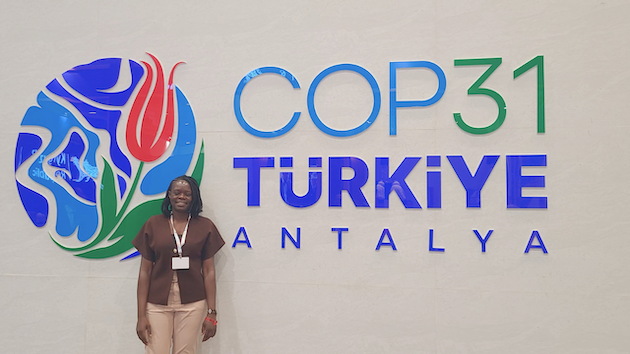
Sherphine Apiyo Kochiyo, a monitoring and evaluation officer at Kenya’s Centre for Environment Justice and Development (CEJAD), attends the COP31 climate summit in Antalya, Türkiye. Credit: GAIA
Wednesday was designated Zero Waste Day at COP31, with discussions focusing on circularity and methane reduction.
But campaigners warned that the growing promotion of waste-to-energy incinerators in African countries risked locking cities into costly infrastructure and diverting investment from waste prevention, composting and recycling.
An average of USD 4.1bn a year in climate finance was tracked for methane reduction in the solid-waste sector in 2021–22, but 94 per cent of that funding — USD 3.86bn — went to projects involving undifferentiated waste incineration, according to the Climate Policy Initiative.
Just USD 223m went to targeted waste-management measures, such as landfill-gas capture and food-waste anaerobic digestion. A further USD 22m was directed to organic-waste management. Sub-Saharan Africa received 57 per cent of the funding for targeted projects, the analysis found.
A report by the Global Alliance for Incinerator Alternatives (GAIA), published in October, identified 15 waste-to-energy incineration projects and proposals across 10 African countries, with combined estimated capital costs exceeding US$4bn.
Public funding was the largest identified source of finance. Yet only one project — the Reppie plant in Ethiopia — was operational. Two others were under construction, while the remaining 12 were at various stages of approval, financing, planning or proposal.
Chythenyen Devika Kulasekaran, a researcher at India’s Centre for Financial Accountability, said companies were increasingly promoting incineration in Africa after pushing the technology in parts of Asia.
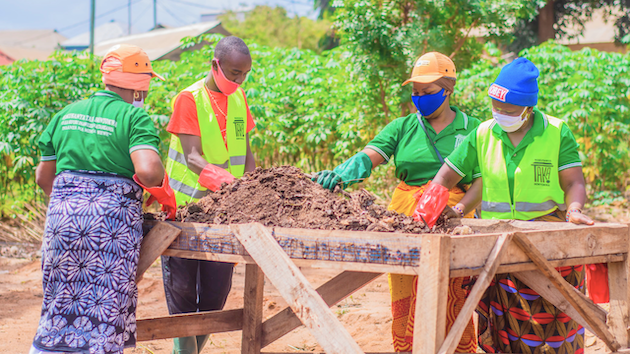
Waste workers with the Nipe Fagio waste collection service sift through compost to remove larger particles during the production of organic fertiliser in Bonyokwa, Dar es Salaam, Tanzania, 2023. Credit: Nipe Fagio
Kulasekaran cited a proposed plant in Casablanca, Morocco, which would be the largest incinerator in Africa if built. An agreement for the project was signed in August, he said, although details of its financing remained unavailable.
Desmond Alugnoa, programme manager for zero waste and climate at GAIA, said governments facing waste-management problems and electricity shortages were attracted by the prospect of generating power from rubbish.
But incinerators required large upfront investments and a constant supply of waste to operate, he said. Alugnoa cited Ethiopia’s Reppie plant, which he said had received substantial public investment but generated relatively little electricity for the national grid compared with its operating costs.
Such projects also risked diverting public money from efforts to reduce waste before it was discarded, Alugnoa said.
Across eastern, western and southern Africa, community-based waste workers are already recovering organic waste and recyclable materials that might otherwise end up in dumpsites and landfills.
In Ngong, located on the outskirts of Nairobi, Kenya, Michael Wangombe collects food waste from markets and nearby businesses and supplies it to a black soldier fly project, where larvae convert the organic material into fertiliser.
Collectors are paid about KSh80 (US$0.62) for each bucket of waste collected. The material is weighed before being fed to the larvae, while the remaining residue is processed into fertiliser for agricultural use.
Wangombe is a member of the Ngong Social Justice and Environmental Centre, whose members have received protective equipment and support in finding buyers through the Danish Refugee Council’s Fair Recycling project.
Maurice Onzere, project manager of the Danish Refugee Council’s Fair Recycling project, said the initiative was helping waste pickers move from informal collection into more structured recycling businesses.
Participants receive training in waste segregation, financial management and market access, and are linked to aggregation centres where they can sell recovered materials to recycling companies.
Further along the waste-recovery chain, Mary Nyambura Kanyui runs an aggregation yard on Juja Road in Nairobi’s Eastleigh area, buying recyclable materials from waste pickers and selling them to recycling companies.
Kanyui spent three years collecting waste before setting up the business nearly six years ago. She now employs five workers, each earning KSh600 ($4.57) a day.
The Danish Refugee Council has helped her establish links with buyers, including recycling companies.
Onzere said women accounted for 57% of the waste pickers engaged by the programme in December 2025, up from less than 12% in 2021. The project works with about 4,000 waste pickers, including refugees and members of host communities.
In Tanzania, the environmental organisation Nipe Fagio works with waste pickers in Dar es Salaam to turn organic waste into fertiliser using black soldier fly larvae. The organisation is also working with the city of Zanzibar on plans for a zero-waste island.
A similar model is being pursued in Ghana, where a project established with Alugnoa’s support converts food and other organic waste into compost for urban farmers. The initiative also works with farmers to demonstrate its use. Despite operating across several municipalities, it processes less than 70 per cent of the city’s organic waste, Alugnoa said.
Durban, South Africa offers another approach. At Warwick Market, a project diverts unsold food from traders for use as animal feed, with the remaining waste sent for composting.
These initiatives were among the approaches discussed at the COP31 Food and Agriculture Pavilion, where practitioners from Tanzania, Uganda and Indonesia shared experiences of using black soldier fly larvae, biogas and composting to manage organic waste and reduce methane emissions.
Piotr Barczak of Africa Circular presented the BUGS project, which supports the development of black soldier fly systems across Africa. Representatives of Tanzania’s Nipe Fagio, Uganda’s Collect Village and GAIA Asia Pacific in Indonesia also outlined how these approaches were being applied in their respective countries.
But expanding such initiatives and the wider systems that support waste recovery requires investment.
Kanyui said she could make a profit of KSh10,000–15,000 (US$77–116) on days when she sold plastic after paying her workers. But banks were reluctant to lend to her because they did not consider the materials and equipment at her yard sufficient collateral.
“Someone goes to the yard the first time and sees rubbish,” she said.
Kanyui said access to a loan would allow her to buy more recyclable materials and that she would be able to repay it quickly.
Kenya’s Sustainable Waste Management Act, passed in 2022, requires waste to be separated at source and makes producers responsible for the environmental impact of products they introduce to the market. Regulations gazetted in November 2024 established an extended producer responsibility (EPR) framework, requiring companies to finance the collection and recycling of waste from their products.
Companies can meet these obligations individually or through producer responsibility organisations (PROs), which collect contributions from members and arrange for the recovery and recycling of discarded materials.
Dorothy Adhiambo Otieno, a programme officer at Kenya’s Centre for Environment Justice and Development (CEJAD), said some PROs had initially subsidised recycling companies buying recovered materials before shifting their support to aggregators, who collect materials from waste pickers and supply them to recyclers.
Some PROs were now exploring direct payments to waste pickers, Otieno said. But workers operating informally faced documentation requirements, including obtaining personal identification numbers from the Kenya Revenue Authority, which could make it difficult for them to receive payments.
Figures published by the Kenya Extended Producer Responsibility Organisation (KEPRO) show that its subsidy framework for September–December 2026 allocates 30 per cent of funding to recyclers, 25 per cent to aggregators, 15 per cent to transporters and the remaining 30 per cent to waste collectors.
Individual waste pickers and community-based organisations can participate through contracted aggregators. Guidance issued by the National Environment Management Authority (Nema) also provides for direct payments to waste pickers at collection points and material recovery facilities.
Producers are required to publish the rates they pay for waste collection services, the guidance says.
Sherphine Apiyo Kochiyo, a monitoring and evaluation officer at CEJAD, said the framework was welcome, but its effectiveness would depend on whether funding reached the workers recovering the waste.
Speaking on the sidelines of COP31, Kochiyo called for greater investment in community-based waste management, including separate collection vehicles for organic and dry waste, support for compost standards and certification, and funding to help community organisations participate in developing waste-management policies.
Campaigners warned that expanding incineration capacity risked diverting investment from waste reduction, recycling and composting. Kulasekaran said the plants’ need for a steady supply of rubbish could also lock cities into long-term dependence on incineration, rather than encouraging efforts to reduce waste at the source.
UN secretary-general António Guterres urged governments to move beyond pledges and increase investment in waste collection, composting and circular infrastructure. Citing projects in Durban, Dhaka and Kampala that convert organic waste into compost, fertiliser and animal feed, he said such initiatives could create jobs and lower costs.
“The era of pledges is over. The world needs action,” Guterres said.
IPS UN Bureau Report