
Genocide Ruling Against Myanmar Sparks Rohingya Celebrations
 20 November 2026
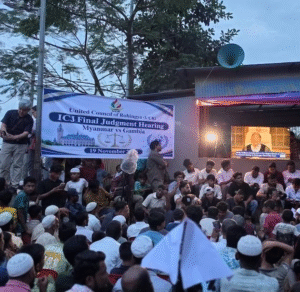
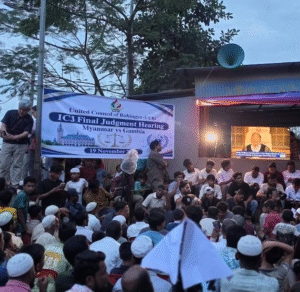
Rohingya refugees in Jamtoli camp, Bangladesh, watch the live hearing of the International Court of Justice in The Hague convicting the state of Myanmar of genocide. Credit: Mohammed Zonaid/IPS
By Mohammed Zonaid and Sara Perria
COX’S BAZAR, Bangladesh & THE HAGUE, Nov 19 2026 (IPS)
Cheers and celebrations erupted in mass refugee camps across the border from Myanmar on Thursday as a landmark world court ruling found the military regime had committed genocide against its Rohingya minority.
Crowds gathered around screens set up in Jamtoli, one of a complex of camps of bamboo and tarpaulin shelters for over one million refugees in Cox’s Bazar, Bangladesh, to listen to the live reading of the verdict of the International Court of Justice (ICJ) in The Hague.
After nearly three hours of reading the court’s final statement, ICJ president Judge Yuji Iwasawa of Japan finally pronounced the first-ever ruling by an international court convicting a state of genocide.
By nine votes to six, he said, the judges of the 80-year-old court established by the UN Charter found that Myanmar had “committed genocide against the Rohingya group in northern Rakhine state”.
Crowds cheered and applauded across Cox’s Bazar as interpreters used loudhailers to convey the message they had waited years for.
“It’s a historic moment for the Rohingya and for the people of Myanmar, for all people who are suffering under different crises around the world. Today the ICJ also recognised the truth and reality, and the world wins today,” declared Mohammed Tofile, a 30-year-old activist.
“It is proof that the world stands against impunity, dictatorship, and brutality. It’s a starting point for accountability,” he told IPS, thanking Gambia for bringing the case to the ICJ, supporters of the Rohingya across the world, and Bangladesh for hosting over one million refugees.
The court’s investigations, hearings and deliberations had taken seven years to complete, focusing mostly on the events of 2017 when the Myanmar military launched what it called “clearance operations” in Rakhine state following attacks by Rohingya militants on police units.
The ICJ’s genocide verdict is sure to trigger widespread debate as the nine judges upholding the conviction found there was sufficient circumstantial evidence to infer genocidal “intent”, an essential element in a decision under the 1948 Genocide Convention.
Some defenders of Israel, and particularly members of the US administration, had warned the 15 ICJ judges not to “lower the bar” in seeking a genocide conviction, fearing a precedent would be set. Israel is facing a case before the ICJ, brought by South Africa, over Gaza.
In reaching 13 separate rulings, the ICJ also found that Myanmar had violated its obligations to prevent genocide committed by individuals alongside its security forces, that it had covered up evidence of crimes of genocide, and that it had failed to enact legislation to prevent genocide, nor had it punished perpetrators.
Specifically, the court found that the numbers of civilians among the more than 10,000 people killed far outweighed combatants and that civilians were killed as they fled to Bangladesh among a total of 700,000 crossing the border.
Sexual violence committed by armed forces and others was “pervasive and systematic”, gang rapes of women were commonplace, and credible estimates indicated that over 730 children under the age of five had been killed. Boys and men were executed. Nearly 400 villages in northern Rakhine were partially or totally destroyed.
During the 2017 “clearance operations”, hate speech against the Rohingya by Min Aung Hlaing – the then military commander who elevated himself to the presidency this year – was systematically disseminated, while the military whipped up anti-Rohingya diatribes through sympathisers on Facebook.
The court set the violence in the context of decades of discrimination and stigmatisation against the mostly Moslem community in predominantly Buddhist Myanmar, with the intent of reducing their numbers. A 1982 law stripped most Rohingya of their citizenship; restrictions in the main township were placed on marriage and childbirth; access to higher education and freedom of movement were denied or curbed.
In another historic first – one that also exposes the court’s lack of powers of enforcement – the ICJ ordered Myanmar to make reparations by facilitating the safe and voluntary return of refugees to their homes, or failing that, compensation. Myanmar was given two years to report back with the ICJ to determine modalities and amounts.
But the reality is that the Myanmar regime has lost control over most of Rakhine to ethnic Arakan insurgents in the civil war that erupted after Min Aung Hlaing ousted Aung San Suu Kyi’s elected government in 2021. Now installed as president, he travels freely these days among neighbouring countries and between his main allies, China and Russia. The US is also engaging with his regime.
The ICJ’s mandate allows it to adjudicate only cases between states, not prosecute individuals, and must rely on the UN Security Council and political pressure to back up its rulings. The UK expressed its support on Thursday and expelled Myanmar’s defence attaché.
The Trump administration had already expressed its displeasure with the ICJ judges before they issued their rulings. The powerful juxtaposition of President Trump joining on Thursday with Russia’s Vladimir Putin in the summit hosted by President Xi Jinping of China did not go unnoticed, with the reform of the UN on the agenda.
Despite all this, the Rohingya know this is their moment of vindication.
“Today the world’s highest court has confirmed what the Rohingya people have said for years: what happened to us was genocide,” said Mohammed Amin, head of the Rohingya Centre of the United Kingdom. He attended the hearing in The Hague with his mother, who carried him out of Rakhine aged three.
“To hear it is very emotional. We were denied for so long, and now the law has recognised the truth, and no one can deny it any more. This judgment belongs to the families in the camps, to those still living in Arakan, and to those we lost,” he told IPS.
Sabekun Naher, founder of Arakan Network for Women’s Rights, was 11 years old when she fled the carnage in Myanmar with her family, her grandfather dying along the way. She told IPS in Cox’s Bazar that she felt goosebumps and cried while listening to the ICJ ruling.
“As a Rohingya woman, I feel incredibly happy. I am sure many other Rohingya women feel the same way, perhaps even more deeply,” she said.
She earnestly thanked The Gambia for its support and the ICJ judges. “Until today, there seemed to be confusion and disagreement over whether the atrocities committed against us constituted genocide and whether we, as Rohingya, truly belong to Myanmar. Today, I feel that this confusion has been clarified and addressed,” she said.
IPS UN Bureau Report