UNCTAD: A Shift of Risk, Geopolitical Tension Weighs on Global Markets Heavier than Trade Policy
 26 Juni 2026

As of now, geopolitics overtook trade policy uncertainty as the primary concern for countries. Credit: Unsplash / Sajimon Sahadevan
By Maximilian Malawista
UNITED NATIONS, Jun 25 2026 (IPS)
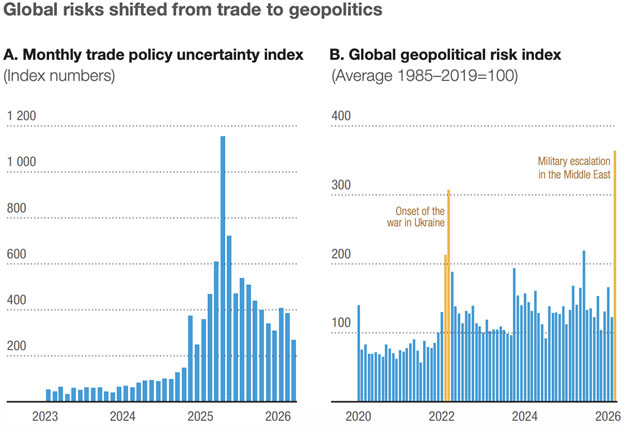
Amidst increased geopolitical tensions, the risk of volatile energy markets, trade corridors, and regional stability in the Middle East has garnered more attention than trade policy in terms of its power to alter the global economy, according to new findings from the United Nations Conference on Trade and Development (UNCTAD).
In their report on trade and development, “Global Economy Faces a Geopolitical Challenge”, UNCTAD says that a protracted escalation “raises the likelihood of deeper disruptions in global trade and finance, potentially, foreshadowing a cascading crisis”.
Credit: UN Conference on Trade and Development (Trade and Development Foresights 2026)
Daily crude oil prices in the Middle East since the beginning of the conflict have risen from around USD 60-70, to a fluctuating rate between a high of over USD 110-. With oil prices surging more than 60 percent, and gas doubling in price, many markets have been left in an inflating scenario as higher energy prices increase macroeconomic pressure and overall slow and contract the economy.
The increase per barrel is largely due to a constriction of supply, where most Gulf economies can barely output oil due to a lack of transport ability through the strait of Hormuz. The International Monetary Fund (IMF) records a spike in the price of Brent crude rising over USD 100 per barrel and remaining at elevated levels, with European gas also jumping roughly “60 percent amid disruptions to LNG exports”.
The numbers are impacted by an estimated loss of capacity of 10 million barrels per day of oil and “about 500 million cubic meters per day of natural gas”. This is roughly 10 percent of global oil production, and roughly 5 percent of global natural gas production for every single day.
The IMF records the following:
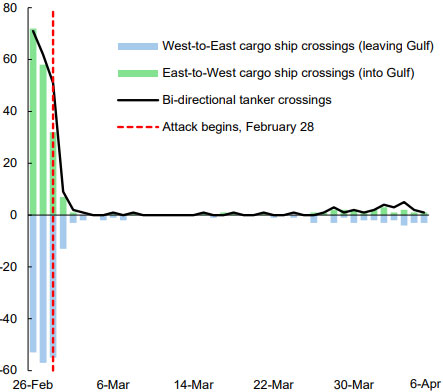
Daily Traffic through the Strait of Hormuz (in number of vessels) between 26 February and 6 April 2026. Credit: IMF
Oil being an inelastic good means that consumers won’t be able to curb their spending. Rather, they have to pay more for as long as the conflict lasts as fuels are needed for many essential routine tasks, from driving your car, to taking your vitamins, to growing your food, and having your Amazon packages shipped.
In their April 2026 Regional Economic Outlook Update for the Middle East and Central Asia, the IMF details that a continued conflict will likely for every 10 percent rise in the average oil price lead to a loss of about 0.5 percent of GDP and an inflation increase of around 1 percent in Gulf economies, ultimately affecting global markets heavily.
As the report notes, “Longer trade disruptions or greater damage to oil production capacity raises the possibility of higher and more sustained oil prices and a larger risk premium than is currently embedded in oil futures prices”.
However, for developing countries higher energy prices hit a lot harder to consumers in developing countries, which in this case don’t have the same money to spare. The IMF warns that “Low-income countries and other fragile and conflict-affected states in the MENAP region are especially vulnerable to higher energy, fertilizer, and food prices”.
Due to the conflict, estimates stand that vulnerable economies, mostly least developed countries (16.1 billion) and small island developing states (4.3 billion), could incur a USD 20 billion a year increase in spending, representing a huge composition of their GDP expenditure.
Among least-developed nations, Mauritania is recorded to have their bill increase by 7.3 percent, The Gambia 6.3 percent, Burkina Faso 5.0 percent, Liberia and Zambia 4.3 percent, with 17 other least developed countries also estimating to increase their spending by at least 0.5 percent in terms of GDP points.
Similarly for small-island developing states, Vanuatu is recorded to have an increase of 5.8 percent, Maldives 5.2 percent, Tonga 4.4 percent, Mauritius 4.2 percent, and Fiji 3.2 percent, with 18 other small developing states recording an increase of at least 0.6%.
UNCTAD also expects this conflict to take away capital investment into developing nations, as these assets are perceived as riskier. The UNCTAD report states that “the start of the Middle East conflict triggered a sell-off of developing countries’ assets, with equity markets of emerging markets sliding by more than 12 per cent between 28 February and 29 March.” Likely such effects will trigger a compacting of issues, contributing to an economic downturn that could take years to recover from depending on the length of the conflict.
IPS UN Bureau Report