Honoring Our Knowledges, Healing Our Mother Earth
20 Oktober 2026agnes
By CS Staff
From October 5–8, 2026, Cultural Survival staff joined the fourth biennial National Tribal Infrastructure Coordination Conference (NTICC) in Reno, Nevada, under the powerful theme, “Honoring Our Knowledges, Healing Our Mother Earth.” As a proud sponsor, Cultural Survival was honored to support this space where Indigenous Knowledge, community leadership, and collective action flourished, connections were made, and resilience was strengthened.
Over the course of four days, relatives, partners, community organizers, and colleagues from around Turtle Island and the globe gathered to hold space, uplift one another, brainstorm ideas, and look for solutions in our ongoing efforts to care for Mother Earth.
Presentations and discussion sessions ranged in topic, but all were connected and intertwined by themes of climate change, community engagement and resilience, land stewardship, cultural revitalization, and food security. Knowledge was exchanged, experiences and ideas were shared, and new solutions and ideas were discussed. Outside the conference rooms and beyond the presentations, learning was also facilitated through workshops, training sessions, and field trips. During a visit to the Desert Farming Initiative and Nevada Native Seed Bank, several participants explored the vital connections between traditional knowledge, seed stewardship, and food sovereignty—even taking part in hands-on seed cleaning.
.png)
Other attendees had the opportunity to visit the Nevada Museum of Art, which included a private tour of the museum’s exhibitions, with special stops at the permanent installation “Of the Earth: Native American Baskets and Pueblo Pottery,” the co-developed rooftop garden “Great Basin Native Basket Plantings,” and a contemporary art exhibition “Listening to the Land.” These exhibit spaces recognize and honor the enduring role of Indigenous Peoples as stewards and caretakers of the land for millennia, inviting visitors to consider how we can collectively care for the Earth and work collaboratively and collectively toward a future that sustains generations to come.
.png)
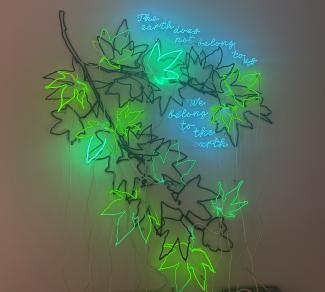
A mural by artist Jeffrey Gibson (Choctaw/Cherokee) that serves as the title and conceptual heart of the “Listening to the Land” exhibition at the Nevada Museum of Art in Reno, Nevada.
Cultural Survival also had the opportunity to speak with current Youth Fellow, Trinity Norris (Tohono O’odham). Trinity is a storyteller, photographer, and media creator dedicated to uplifting Indigenous voices and strengthening community resilience through intentional, relationship-centered work. Through her fellowship project, “Carrying Our Stories Forward: A Portrait & Micro-Story Project Uplifting O’odham Language Through Community Storytelling on Traditional Foodways,” Norris aims to enhance the visibility and pride of the O’odham language and people. By documenting meaningful words and memories through portraits, audio reflections, and micro-stories, the project creates a culturally grounded archive that strengthens identity, supports language revitalization, and highlights intergenerational knowledge. Trinity reflected on the importance of her work:
“This work is important to me because this is Mother Earther, and as we take care of this land, and as we steward the land – the land takes care of us. That reciprocity between the land and us as Native Peoples is really important.”
.png)
Trinity Norris (Tohono O’odham), 2026 Cultural Survival Youth Fellow, is interviewed by Byron Tenesaca (Kañari Kichwa), Cultural Survival’s Fellowships Coordinator.
In celebration, participants joined Cultural Night hosted at the Nevada Museum of Art. Traditional foods, dances, and Indigenous art reminded us that our relationships with the land are living, powerful, and deeply rooted in ancestral knowledge. It was another opportunity to honor the original and continuing sovereignty of the lands of the Numu, Nuwu, and Washo Peoples, whose ancestral lands we were welcomed onto and who continue to sustain life and culture on these territories.
As the conversation progressed throughout the week, one strong message remained: climate change touches everything, so we need to be in every space. It is so important that we recognize our roles as stewards of the Earth. We must all come together as one, work in unison, and share resources and knowledge, while amplifying the Indigenous voices that will guide us on the path towards ensuring a future where we will thrive together with all our relatives.