Indigenous Communities in South Kivu Reclaim Land Rights Amid Mining Expansion
14 Agustus 2026diana

By Veronique Wanyema Saleh, Coordinator, Femmes Pymees en Action (FEPA), Radio Kivu, FM Congo
In the territories of Uvira, Mwenga, and Fizi in the Democratic Republic of Congo, Mbuti and Batwa Peoples, facing serious environmental and social harm from transition-mineral mining, are taking an important step toward self-determination. For years, mining companies have failed to obtain Free, Prior and Informed Consent from the communities. The mines have destroyed forests, polluted rivers, and caused forced displacement of families from their ancestral lands. Women and youth were the most affected, as they were excluded from decision-making processes about how their own resources were used.
Today, this is beginning to change. Through the initiative led by Femmes Pymees en Action (FEPA) with support from Cultural Survival, Indigenous communities are gaining knowledge and asserting their rights. They are moving from being victims of exploitation to becoming informed advocates who stand up for their land rights and for justice.
The initiative, which includes legal training with community-led media, has reached over 800 people directly, giving them tools to navigate complex mining codes and land laws. By producing radio programs in Indigenous languages like Kibembe and Kifuliru and using traditional theater and mobile cinema, the initiative has bridged the literacy gap. For the first time, hundreds of villagers now understand their rights.
So far, this awareness-raising initiative has led to victories in over 20 major land dispute cases and the acquisition of 43 formal land documents with support from trained community paralegals. In the village of Aboke, women and young people have become so vocal in denouncing the illegal destruction of fields by armed groups and mining companies that local authorities were forced to intervene and stop the operations.
The human impact of this empowerment is clear in the people’s own words. Nseke, a Batwa woman, says, “Before, I didn’t dare speak at village meetings. Now I know my rights and can defend my land. I feel stronger and more useful in my community.” Lukono, a Batwa man who received legal assistance in collaboration with an Indigenous law firm in Bukavu, says, “Before, I did not know how to respond to mining companies. Thanks to legal support, I was able to resolve my family’s land dispute and protect our land.”
This sentiment is echoed by Chief Mbusa of the Mbuti People, who observed that this initiative has strengthened dialogue between generations and genders, bringing a new sense of peace and solidarity. Young leaders are also emerging. “Thanks to the training and workshops, I have learned how to collect evidence and document land abuses. I can now help my community protect itself against injustices,” Bondo says. Beyond legal aid, the initiative has also encouraged environmental protection and collective action. “I understand the importance of protecting our rivers and forests. Now I can explain to my neighbors why our resources are precious and why we must defend them,” says Kanyembo (Mbuti), one of the participants in the paralegal training.
One of the most striking examples of success comes from Nyamusi, President of the Mwanamuke Kujiamini group. Her community’s fields were nearly seized by a mining company at the Kakolokelwa deposit. “We found a notice saying that we had to harvest all our crops within four months,” she recalls. “Thanks to FEPA’s paralegals, we were able to defend our rights before the company and the group leader, and our fields were saved. Today we received a letter from Olive Mining inviting us to negotiate the terms of our land. This initiative shows us that women, even in forgotten communities like the Mbuti, can bring about real change.”
As these communities continue to monitor the commitments of mining companies and authorities, the strong base of legal knowledge and mutual aid networks helps ensure that their struggle for dignity and land remains at the heart of life in South Kivu.
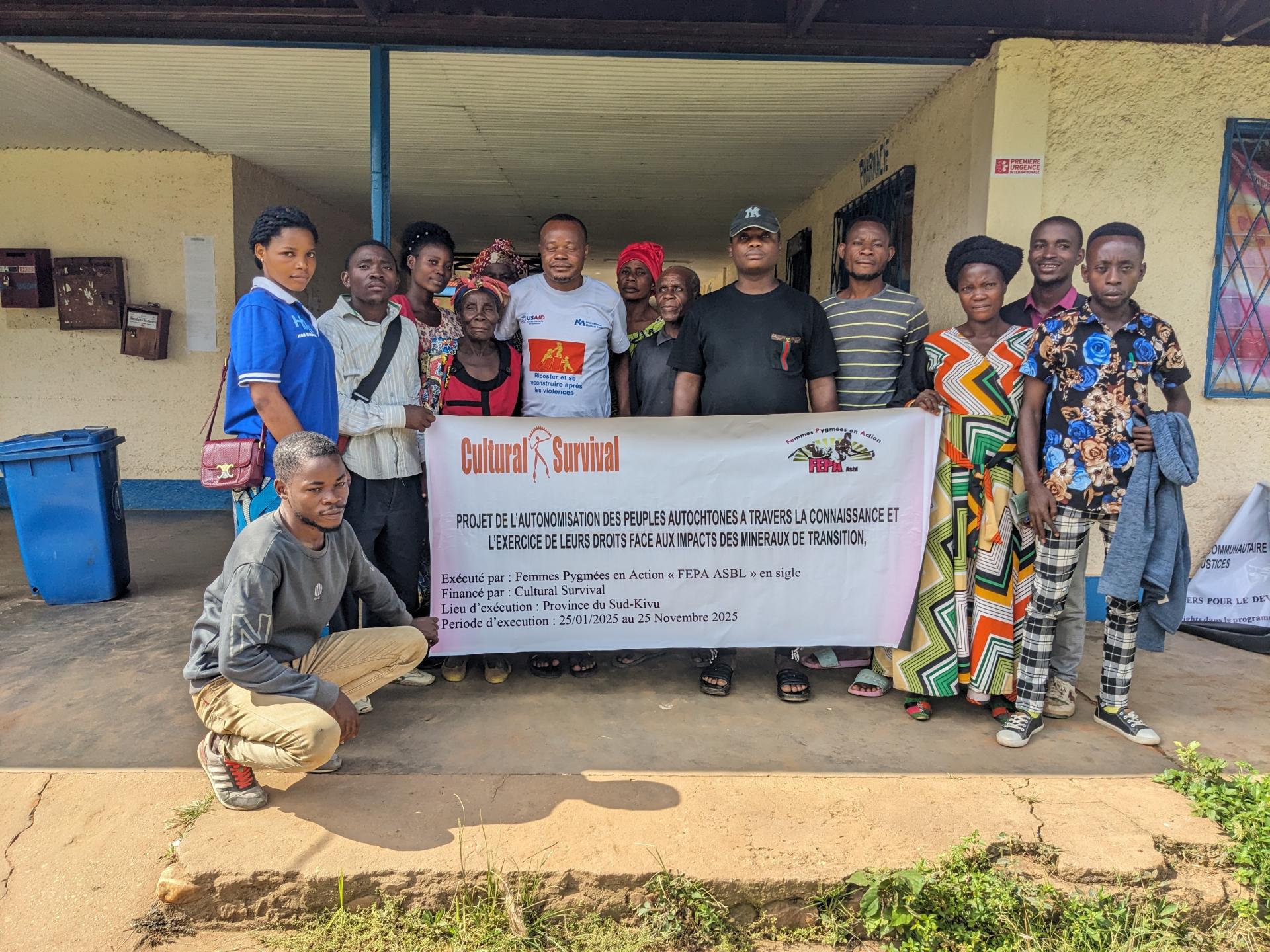
In 2025, Radio Kivu, FM Congo received a grant from Cultural Survival’s Indigenous Community Fund, which provides opportunities for journalism, broadcasting, audio editing, technical skills, and more for community media from Indigenous communities around the world. In 2025 CS awarded a total of $502,000 to 63 Indigenous communication projects that will benefit Indigenous Peoples in 29 countries: Argentina, Bangladesh, Bolivia, Botswana, Brazil, Chile, Ecuador, Colombia, United States of America, Philippines, Guatemala, India, Kenya, Mexico, Nepal, Peru, South Africa, Democratic Republic of Congo, Indonesia, Honduras, Mali, Nicaragua, Cambodia, Chile, Canada, Panama, Paraguay, Papua New Guinea, New Zealand, Nicaragua, and Tanzania.