
Sudan’s War Economy: Funded By Gum Arabic And Gold
 28 Juli 2026
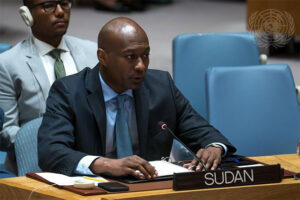
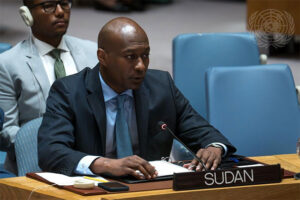
Ammar Mohammed Mahmoud Mohammed, Deputy Permanent Representative of the Republic of the Sudan to the United Nations, addresses the Security Council meeting that heard reports of the Secretary-General on Sudan. Credit: UN Photo/Mark Garten
By Oritro Karim
UNITED NATIONS, Jul 27 2026 (IPS)
In the three years since the outbreak of the Sudanese Civil War, the humanitarian crisis has deteriorated significantly, with the United Nations underscoring a blatant disregard for international humanitarian law among warring parties. This includes the deliberate targeting of civilians in residential areas, widespread sexual violence, and attacks on critical infrastructure that have hindered aid efforts and pushed communities to the brink of collapse. To manage rising military expenses, the warring parties have increasingly relied on the exploitation of trade routes and territories, prompting humanitarian experts to express concern about a persistent, self-sustaining “war economy.”
“Sudan’s vast wealth of natural resources should benefit its people. Distressingly, what we are seeing today is anything but that. In fact, this wealth is only serving to undermine human rights and drive conflict, bringing pain and suffering on an enormous scale,” said UN High Commissioner for Human Rights Volker Türk. “This war economy must be disrupted, and the international community must pay much closer attention to the commodities and trade routes that help keep it alive.”
On July 15, the United Nations Office of the High Commissioner for Human Rights (OHCHR) published a report titled Business and Human Rights in Conflict: Gum Arabic from Sudan, underscoring how the illicit trade of gum arabic is being exploited to fund the violent activities of both the Rapid Support Forces (RSF) and the Sudanese Armed Forces (SAF). Beyond gum arabic, the report shows that warring parties are generating massive revenues from gold, livestock, and other commodities by seizing control of local extraction, transport, and trade routes.
Historically, gum arabic has been a critical economic staple for Sudan, serving as a key ingredient in food, drinks, cosmetics, and pharmaceuticals around the world. Sourced from the bark and branches of the acacia tree, gum arabic acts as a lifeline for over five million people in Sudan, remaining deeply embedded in local rural communities.
Before the eruption of hostilities in 2023, Sudan’s gum arabic trade accounted for roughly 70 to 80 percent of the global crude gum arabic exports, with annual exports reaching as high as USD $183 million. Today, the vast majority of acacia forests in Sudan—which form the country’s “gum arabic belt”—are located in regions that are largely under RSF and SAF control, such as Kordofan and Darfur.
The report found that rural communities relying on gum arabic for financial stability have faced numerous protection risks and severe human rights abuses—including looting, extortion, and arbitrary detention. This further compounds the struggles of their daily lives as they face shrinking access to basic services, such as food, clean water, education, and healthcare.
Traders working along corridors stretching through RSF-controlled sections of Darfur and Kordofan have experienced confiscation of goods, excessive taxation, and violence. Additionally, the report notes that considerable quantities of gum arabic have been redirected by the RSF from West Kordofan and Darfur to Souq al-Na‘am, South Sudan, Juba, Chad, Cameroon, and Kenya. Furthermore, the UN has reported that lootings of gum arabic conducted by the RSF are often used as a form of compensation rather than traditional salaries, with roughly 3,700 tonnes looted between January and June of 2024.
OHCHR noted that gold is also a primary driver of Sudan’s war economy, being considered “the most financially significant commodity in export terms”, as well as a major source of revenue for the RSF and SAF. Figures from the Central Bank of Sudan and the Sudanese Mineral Resources Company show that in 2024, roughly 65 tonnes of gold were produced in SAF-controlled areas, including 28 tonnes that were exported through Port Sudan. This generated approximately USD $1.6 billion in revenue, contributing to 48.5 percent of the nation’s annual exports.
Despite gold production climbing to 70 tonnes in 2025, considerable portions of the gross output have been smuggled outside of the country. According to the report, in 2024, only 52 percent of the annual gold exports were passed through formal export channels. Additionally, RSF-affiliated economic entities continue to extract and trade gold from Darfur and Kordofan, with the RSF seizing over 1.3 tonnes of unrefined gold early in the conflict.
“Gold is the most important and decisive financial driver, while gum arabic provides supporting liquidity and demonstrates how the war has extended into agricultural commodities and global trade routes,” said Dr Abdelmonem Mukhtar, Executive Director of the Centre for Evidence and Data-Based Policy. “If it is established that a supply chain contributes directly or indirectly to financing parties to the conflict, regulatory, civil or ethical responsibilities may arise, in addition to reputational and commercial risks.”
Emphasizing the need for more rigid oversight, Türk called on UN member states to strengthen accountability and monitoring measures to ensure that commodity trade in Sudan does not fund violations of international humanitarian law, but rather helps to alleviate the suffering of civilians. He also urged corporations to prioritize human rights.
“Companies cannot continue business as usual when sourcing from conflict-affected value chains,” Türk said. “They should undertake heightened, conflict-sensitive human rights due diligence, including stronger scrutiny of routes, intermediaries, documentation and possible re-labelling, and ensure that affected people have access to safe and effective grievance and response mechanisms.”
IPS UN Bureau Report