Understanding Tenurial Conflict, Paving the Way to Resolution
 21 October 2026
It is widely understood that few forest areas in Indonesia are free of tenurial conflict. These disputes rarely stem from a single cause. Overlapping claims, unclear boundaries, competing interests, and community access to land can all be intertwined. For those working to address conflict, that complexity makes it essential to understand the situation as a whole and listen carefully to the parties and stakeholders before taking action.
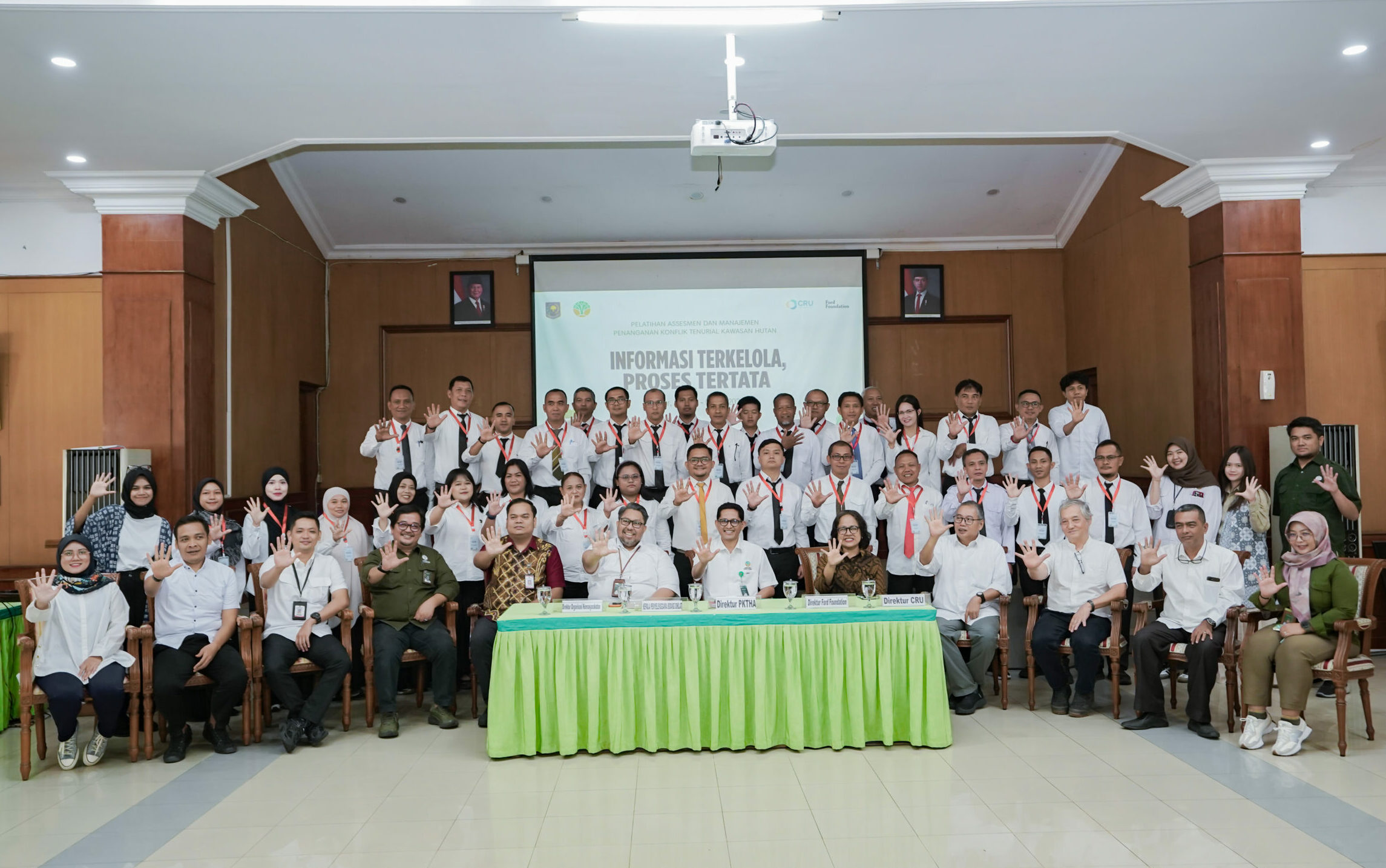
That understanding underpinned the Forest Tenurial Conflict Assessment and Management Training, held September 30–October 5, 2026, at the Ministry of Forestry’s Human Resources Education and Training Center (Pusdiklat SDM Kemenhut) in Gunung Batu, Bogor. The program was organized through a collaboration among CRU Indonesia, the Directorate of Tenurial Conflict and Customary Forest Management (PKTHA), and the Ministry of Forestry’s Human Resources Education and Training Center. It offered participants a chance to strengthen the knowledge and skills needed to address tenurial conflict more systematically.
Participants came from a range of regional institutions, including the Ministry of Forestry, local governments, Social Forestry Offices, and Forest Management Units (KPH), representing Aceh, Jambi, West Java, East Java, Central Sulawesi, and East Nusa Tenggara. Their experience varied: some had handled conflicts in the field, while others wanted to build their skills for future assignments. Those experiences enriched discussions and case exercises, particularly by bringing different perspectives to the same problems.
The training moved from concepts to practice. Participants worked through case studies, mapped conflict actors and drivers, examined the parties’ claims, and developed assessment plans alongside possible resolution processes. Group discussions showed how little is often known at the outset of a conflict—and how readily the same information can lead to different interpretations. That is why careful screening, verification, balanced data gathering, and neutral, impartial recommendations matter.
The learning environment also made room for participants from different regions and institutions to exchange experience. They shared perspectives, tested their analyses together, and practiced looking at conflicts from more than one side. The curriculum combined theory and practice through a participatory, experience-based approach, helping participants connect what they learned to their day-to-day work.
Sessions were led by several resource persons: Julmansyah, Director of PKTHA; Arief Wicaksono, Director of CRU Indonesia; Nur Faizin, Head of the Subdirectorate for Tenurial Conflict Management; Dwi Rahmanendra, instructor at the Ministry of Forestry’s Human Resources Education and Training Center; Ginanjar Tamimy, Engagement and Networking Manager at CRU Indonesia; Ilya Moeliono, Senior Advisor at CRU Indonesia; Heru Purwanto, First Expert Forest Ecosystem Controller at PKTHA; and Fellizka Rezmiaty, Junior Expert Forestry Extension Officer.
The training officially concluded on Monday, October 5, 2026, with remarks from Catur Endah Prasetiani, Director General of Social Forestry at the Ministry of Forestry, following a program report from Tuti Herawati, Head of the Forestry Education and Training Center. The closing marked the end of the training and the beginning of work informed by it: understanding conflicts through sound assessment and designing responses that reflect the findings and the parties’ needs.
One training alone cannot resolve Indonesia’s tenurial conflicts. This program is an initial step in a broader effort: an initiative by the Directorate of PKTHA to decentralize the mechanism for addressing conflict in forest areas and build regional capacity to put it into practice.